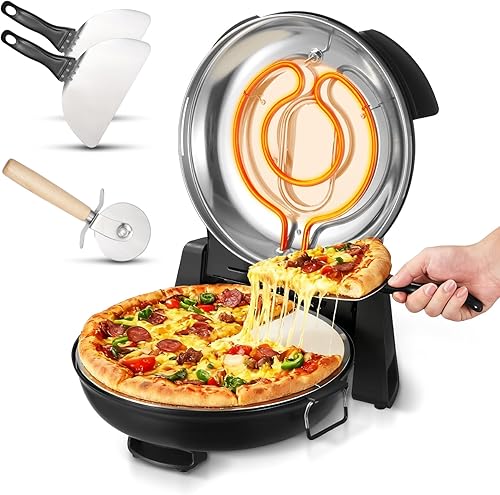
A countertop pizza oven heats faster and more evenly than a standard kitchen oven, which typically tops out around 500 degrees Fahrenheit and forces your pizza to compete with the oven cavity for heat. Dedicated pizza ovens concentrate heat from the bottom up, giving you a crispier crust without the long preheat. The market ranges from flat, lidded designs that sit under 10 inches tall to stainless steel units capable of hitting 660 degrees Fahrenheit or more. Price spans from under $40 to over $500, and the right choice depends heavily on how much counter space you have, how often you cook pizza, and whether you want something that doubles for other foods. We ranked every model in this list by verified buyer volume, review count, star rating, and how much spec you get per dollar. You will not find a pick here rated below 3.8 stars or backed by fewer than 100 reviews unless it offers a spec advantage that no other model matches at its price.
Short answer: The Presto 03430 (ASIN B00005IBXJ, $85.67, 4.7 stars, 20,728 reviews) is the most proven countertop pizza oven on the market by a wide margin. If you want the lowest entry price, the Chefman RJ58-EM-CONCRETE (ASIN B0D3RL8BG4, $39.96, 4.5 stars, 1,619 reviews) delivers a legitimate pizza oven experience under $40. The Presto wins on overall trust and consistency, while the Chefman is the clearest value pick for budget shoppers.
The Presto 03430 has 20,728 reviews and a 4.7-star rating, which is the largest pool of verified buyer feedback in this entire category by more than 10 times. It draws 1,235 watts, weighs 7.6 pounds, and measures 14.5 by 15.8 by 10.3 inches with a nonstick ceramic finish interior. At $85.67 it is not the cheapest pick, but no other pizza oven in this price range comes close to matching its track record of consistent buyer satisfaction.
Best for: Anyone who wants the most proven, highest-rated countertop pizza oven available without complexity or guesswork.
Pros
20,728 reviews at 4.7 stars is the most trusted signal in this category
1,235-watt heating element in a compact 7.6-pound body
Knob controls are simple and reliable for daily use
Available in stock at $85.67 with wide retailer distribution
Cons
No published max temperature spec to verify exact heat ceiling
1,235 watts is on the lower end for buyers who want fast repeat-baking
Bottom line: If you only read one entry on this page, this is it. The Presto 03430 is the closest thing to a consensus pick that exists in countertop pizza ovens.
The Chefman RJ58-EM-CONCRETE delivers a real pizza oven experience at $39.96 with 1,619 reviews backing a 4.5-star rating, which is extraordinary social proof for a product under $40. It measures 15 by 13 by 4 inches and weighs 6 pounds, making it one of the lightest and most storable picks in the lineup. The concrete color finish is distinctive, and the metal-and-plastic construction keeps the price accessible without cutting corners on function.
Best for: Budget shoppers, college dorms, small kitchens, and anyone who wants a proven pizza oven experience without spending over $40.
Pros
1,619 reviews at 4.5 stars proves consistent buyer satisfaction at the $40 price point
Lightest easy-store option at 6 pounds and only 4 inches tall
Compact 15 x 13-inch footprint fits on smaller counters
Lowest price in the lineup at $39.96 from a recognized appliance brand
Concrete color finish stands out from the standard black and silver options
Cons
No wattage or max temperature listed, limiting direct spec comparisons
Plastic-and-metal build is less durable than all-stainless options under heavy daily use
Bottom line: The Chefman RJ58-EM-CONCRETE is the most compelling value in this category. A 4.5-star rating across 1,619 reviews at under $40 is hard to argue with.
The Commercial CHEF BC-4958CR is the only other sub-$50 pick in this list, coming in at $39.99 with 383 reviews at 4.4 stars. It draws 1,500 watts, has a documented max temperature of 401 degrees Fahrenheit, and weighs 6.5 pounds with a 13.8 by 15.9 by 5-inch footprint. The painted red finish and plastic casing are consistent with the price point, and the knob controls keep operation simple.
Best for: Buyers who want a sub-$40 pizza oven with the most wattage in that price tier and a verified max temperature spec.
Pros
1,500 watts puts it ahead of many pricier models on raw wattage
Documented 401-degree max temperature, which is transparent spec data
4.4-star rating across 383 reviews signals solid buyer satisfaction
Under $40 with knob controls and a compact 6.5-pound body
Red color option for kitchens that want a pop of color
Cons
Painted plastic exterior is less durable than stainless steel over repeated heat cycles
401-degree max temperature limits results with fresh homemade dough
Bottom line: The Commercial CHEF is a solid secondary budget option if the Chefman is out of stock, with better wattage and a documented temperature ceiling.
The Courant CPM1240R draws 1,440 watts and is built on a carbon steel body, available in a red colorway at $73.97 with 549 reviews at 4.3 stars. It measures 15 by 12 by 5 inches and weighs 28 pounds, which is notably heavier than most competitors at this price, suggesting a solid and well-built chassis. Knob controls keep operation straightforward, and the carbon steel construction should hold heat more consistently than thinner-gauge materials.
Best for: Buyers who want a sturdy, heavier-duty pizza oven in the $70 to $80 range that will stay put on the counter and not feel flimsy.
Pros
Carbon steel construction is more durable than plastic-cased competitors
549 reviews at 4.3 stars confirms consistent buyer approval
1,440 watts at $73.97 is competitive wattage-per-dollar for the mid range
15 x 12-inch footprint fits most counter layouts
Distinctive red finish in a market dominated by black and silver
Cons
28-pound weight makes it inconvenient to store in a cabinet between uses
No published max temperature spec available
Bottom line: The Courant CPM1240R is the most substantial-feeling option in the $70-range tier, with carbon steel construction and solid buyer confidence behind it.
The Goplus pizza oven draws 1,450 watts from a stainless steel and chrome body, priced at $62.29 with 620 reviews at 4.1 stars and a light 5.87-pound frame. It uses knob controls and a brushed stainless finish that holds up to heat and moisture better than painted surfaces. At $62.29 it occupies a clean gap between the sub-$50 budget picks and the $70-plus mid-range options, offering real stainless construction at a lower price than most competitors.
Best for: Buyers who want a stainless steel pizza oven under $65 without stepping up to the $70 to $90 tier.
Pros
Stainless steel and chrome construction at a sub-$65 price point
1,450 watts for fast preheat and consistent cooking
620 reviews at 4.1 stars provides solid buyer validation
5.87-pound weight makes it easy to move or store
Brushed stainless finish resists heat discoloration better than painted alternatives
Cons
4.1-star rating is the lowest among the top-tier picks, signaling more mixed experiences
No published max temperature or interior dimensions available
Bottom line: The Goplus offers the best materials you can get in a sub-$65 pizza oven, though the 4.1-star rating means a larger fraction of buyers have had mixed results.
The Vevor QL36WT draws 1,200 watts from a metal construction in black at $69.99 with 287 reviews at 4.0 stars. It measures 15 by 13.78 by 7.48 inches and weighs 11.24 pounds, giving it a footprint and weight that feels more substantial than its price suggests. Knob controls are standard, and the build quality for a Vevor product at $69.99 is generally above what most buyers expect from the brand at entry pricing.
Best for: Buyers open to the Vevor brand who want a metal-construction pizza oven under $70 with real buyer reviews behind it.
Pros
287 reviews at 4.0 stars at $69.99 offers reasonable entry-level confidence
11.24-pound body feels more solidly built than lighter plastic alternatives
Metal construction at a price where competitors use plastic
Knob controls and a 7.48-inch height that accommodates thicker pies
Vevor brand support and return policy available through Amazon
Cons
1,200 watts is the lowest wattage in the mid-range tier, slowing preheat times
4.0-star rating and no published max temperature limit how strongly we can recommend it
Bottom line: The Vevor QL36WT is an acceptable mid-range option if the Goplus or Courant are unavailable, but the lower wattage and 4.0-star ceiling make it a third-tier pick in the $70 range.
The NutriChef NCPZTP120BK draws 1,200 watts and weighs only 5.51 pounds in a 13.38 by 12.99 by 6.49-inch aluminum, plastic, and stainless steel body priced at $89.99 with 205 reviews at 4.1 stars. It is the smallest and lightest pick in the sub-$100 tier, which makes it ideal for tight counters or frequent storage. Knob controls are standard, and the black colorway is clean and kitchen-neutral.
Best for: Buyers who prioritize compact size and light weight above all else and need something that stores easily in a small kitchen.
Pros
5.51-pound weight is the lightest option in the $80 to $90 range
Compact 13.38 x 12.99-inch footprint for tight counter spaces
205 reviews at 4.1 stars provides baseline buyer confidence
Aluminum and stainless steel construction adds durability at the price
Clean black colorway fits most kitchen aesthetics
Cons
1,200 watts is the lowest wattage in this tier, meaning slower preheat
At $89.99 it costs more than the Presto 03430 while offering less review confidence
Bottom line: The NutriChef NCPZTP120BK is the right call if counter space and storage weight are your binding constraints, though the Presto 03430 is a better overall value at a similar price.
The MisterChef BP300 draws 1,450 watts from a ceramic-material body in black at $59.99 with 160 reviews at 4.3 stars. Ceramic construction offers better heat retention than metal and is easier to clean after cheesy spills. Brushed finish knob controls are standard, and at 1,450 watts the MisterChef lands in the same heating tier as the Goplus and Courant but at $59.99, slightly under both.
Best for: Buyers who want ceramic construction and strong wattage under $60, particularly those who value easy interior cleanup.
Pros
Ceramic material construction for better heat retention and easy cleanup
1,450 watts at $59.99 is strong wattage-per-dollar in this tier
4.3-star rating across 160 reviews is above-average for this price range
Brushed black finish is kitchen-neutral and hides surface marks well
Slightly lower price than comparable wattage competitors
Cons
160 reviews is a smaller sample than top-tier picks, reducing statistical confidence
No published max temperature or interior dimensions to verify fit
Bottom line: The MisterChef BP300 punches above its price with ceramic build quality and 1,450 watts, though the smaller review pool means slightly more uncertainty than the top-ranked picks.
The Vevor FY-1EP-2 reaches a documented 662 degrees Fahrenheit using 1,800 watts from a brushed and polished stainless steel body, priced at $249.99 with 116 reviews at 4.2 stars. It measures 24.2 by 20.1 by 22.44 inches and weighs 54 pounds, which means it is not a unit you move around. Button controls replace the standard knob layout, and this is the closest thing to a serious pizza oven in the sub-$300 category.
Best for: Home pizza enthusiasts who make fresh dough regularly and want the highest achievable temperature in a countertop electric unit under $250.
Pros
662-degree Fahrenheit max temperature is the highest verified heat ceiling in this list
1,800 watts delivers fast preheat even at high target temperatures
Stainless steel construction throughout with polished and brushed finish
116 reviews at 4.2 stars confirms real buyer use at this price tier
Button control panel for more precise temperature adjustment
Cons
54-pound weight and 24-inch width means it stays on the counter permanently
At $249.99 the price-to-review ratio is less favorable than sub-$100 picks
Bottom line: If you are serious about fresh pizza and want real high-heat performance without going above $250, the Vevor FY-1EP-2 is the only pick in this list that delivers a documented 662-degree ceiling.
The Crosson pizza oven reaches 660 degrees Fahrenheit with 1,600 watts from a polished stainless steel body at $258 with 92 reviews at 3.8 stars. It measures 22.04 by 23.03 by 11.34 inches and weighs 21.82 pounds, which is more portable than the Vevor FY-1EP-2 despite similar temperature capability. At a 3.8-star rating it sits right at the floor for inclusion, and the 92-review sample is smaller than we prefer, but the 660-degree ceiling at $258 offers a real price-to-performance argument for the high-heat category.
Best for: Buyers who want high-temperature performance near the $250 range and prefer a lighter unit than the Vevor FY-1EP-2.
Pros
660-degree Fahrenheit max temperature matches the Vevor at $8 less
1,600 watts in a 21.82-pound body that is more portable than 54-pound competitors
Polished stainless steel finish resists heat discoloration and cleans well
22-inch footprint is large but stays within standard counter depth
Cons
3.8-star rating at 92 reviews is the lowest confidence level in this list
At $258 you are paying a premium with less buyer verification than sub-$100 picks
Bottom line: The Crosson is a credible high-heat option but the 3.8-star rating and small review pool mean you are taking more of a gamble than with any other pick on this list.
The Wisco 561 at $468 has only 59 reviews, which is far too small a sample to justify confidence at a $468 price point. There are better-verified options at half the cost.
The Koolatron KKIPO12 at $319.59 has only 18 reviews. At that price you deserve hundreds of reviews confirming it performs as advertised, and this one does not have them.
The Crosson at $569 weighs 71.9 pounds and has only 79 reviews at 4.1 stars. The weight, price, and thin review base make it hard to recommend when the Vevor FY-1EP-2 delivers similar heat at $249.99 and 54 pounds.
The Vevor PSL-36 at $799.99 has 23 reviews and no published specs whatsoever. No temperature, no wattage, no dimensions. Skip it entirely until there is real buyer data and transparent specs.
The Shikha at $369.99 has only 46 reviews at 3.9 stars. A 3,000-watt draw at that price with so few reviews and a borderline rating is not a combination we can recommend with confidence.
Buying guide
How Much Wattage Do You Actually Need
Most countertop pizza ovens in this list draw between 1,200 and 1,800 watts. A 1,200-watt unit like the NutriChef NCPZTP120BK or Vevor QL36WT will cook a pizza, but it will take longer to preheat and may struggle to produce a crispy bottom on thick-crust pies. The sweet spot for home use is 1,440 to 1,500 watts, which is where the Courant CPM1240R, Commercial CHEF BC-4958CR, and MisterChef BP300 all land. If you want to cook fast and repeat-bake multiple pies without long cool-down waits between rounds, look at 1,600 watts and above. The Crosson B0BFHMKKYM at 1,600 watts and the Vevor FY-1EP-2 at 1,800 watts both fall in that upper tier. Higher wattage pulls more from your outlet, so check your kitchen circuit capacity before buying anything above 1,500 watts.
Max Temperature Matters More Than Most Buyers Realize
Neapolitan-style pizza traditionally bakes at 800 to 900 degrees Fahrenheit in a wood-fired oven, which is out of reach for any countertop electric unit. That said, the gap between a 400-degree oven and a 660-degree oven is enormous in practical terms. The Commercial CHEF BC-4958CR maxes out at 401 degrees Fahrenheit, which works for thin frozen pizza but will not give you the leopard-spotted crust that characterizes a well-baked fresh pizza. The Crosson B0BFHMKKYM and the Vevor FY-1EP-2 both top out around 660 degrees Fahrenheit, which gets you noticeably closer to real pizzeria results. If you are making fresh dough from scratch and care about crust texture, prioritize units with a documented max temp of 550 degrees Fahrenheit or higher. For reheating delivery pizza or cooking frozen pies, a standard 400-degree unit will do the job fine.
Size and Footprint: Measure Your Counter First
Countertop pizza ovens are wider than they look in product photos. The Presto 03430 measures 14.5 by 15.8 by 10.3 inches, which requires a solid 16-inch-deep footprint including clearance from the wall. The Vevor FY-1EP-2 goes even larger at 24.2 by 20.1 by 22.4 inches and weighs 54 pounds, which means it stays put once you find a home for it. The Chefman RJ58-EM-CONCRETE is more compact at 15 by 13 by 4 inches and weighs only 6 pounds, making it easy to store in a cabinet between uses. Before buying, measure the space on your counter including clearance above the unit, because most pizza ovens radiate significant heat from the top and sides and need at least 4 inches of open space on all sides to operate safely.
Controls: Knob vs. Touch
Nearly every model in this list uses knob controls, and for a pizza oven that is actually the better choice. Knob controls are faster to adjust mid-cook, more reliable near heat and moisture, and easier to read at a glance. The Koolatron KKIPO12 is the only touch-control unit in this category, and while touch panels look modern, they are more prone to failure over time in a high-heat environment. The Vevor FY-1EP-2 uses button controls, which split the difference. For most buyers, a simple timer knob and temperature knob is all you need, and the Presto 03430 and Chefman models both deliver exactly that without any complexity.
Material and Durability: What the Casing Tells You
Pizza ovens run hot, and casing material is a real indicator of long-term durability. Stainless steel exteriors, found on the Goplus, Vevor FY-1EP-2, Crosson, and Wisco models, handle heat cycles better than painted plastic exteriors over time. The Commercial CHEF BC-4958CR uses a plastic-and-paint shell, which is part of why it costs $39.99 and works fine for light use but may show wear faster with daily operation. Ceramic-finish interiors, like the one on the Presto 03430, are easier to wipe clean than bare metal. The MisterChef BP300 uses a ceramic material construction that cleans up well after cheesy spills. Whatever casing you choose, check whether the unit includes a removable crumb tray or drip pan, because cleaning the interior of a fixed-bottom pizza oven is genuinely frustrating without one.
Budget Tiers: What to Expect at Each Price Point
Under $50 you get functional pizza ovens with basic controls and modest max temperatures, represented here by the Chefman at $39.96 and the Commercial CHEF at $39.99. Both have strong ratings relative to their price but neither will rival a true high-heat oven. From $60 to $90 you enter the core market where most buyers land, covering the Goplus at $62.29, MisterChef at $59.99, Vevor QL36WT at $69.99, Giantex at $69.99, Courant at $73.97, Presto at $85.67, and NutriChef at $89.99. This range gives you more wattage, better materials, and more buyer data to trust. From $200 to $270, the Crosson B0BFHMKKYM at $258 and Vevor FY-1EP-2 at $249.99 offer significantly higher max temperatures for cooks who want serious bake results. Above $300, review counts thin out fast, which makes it harder to verify real-world satisfaction before buying.
Common mistakes to avoid
Buying based on wattage alone without checking max temperature, since two ovens at 1,450 watts can produce very different heat ceilings depending on insulation and heating element placement.
Ignoring footprint dimensions and buying a unit that is too large for the counter space available, then storing it on the floor or in a hard-to-reach cabinet.
Expecting a countertop pizza oven priced under $50 to replicate high-heat artisan pizza results, then leaving a negative review when a frozen pizza comes out the same as it would from a regular oven.
Skipping the preheat cycle and loading the pizza into a cold oven, which results in a soft, undercooked bottom crust regardless of how capable the machine is.
Choosing a model based on looks or color without verifying the return count relative to the review count, which is the best public signal of how often buyers regret a purchase.
Overlooking the cleanup requirements before buying, particularly with models that do not include a removable drip tray, since cheese and sauce runoff bakes onto fixed surfaces quickly.
Frequently asked questions
Can a countertop pizza oven replace a full-size oven for everyday cooking?
For pizza specifically, yes, a countertop unit will outperform a standard oven in most cases because it heats faster and concentrates heat more directly. For other cooking tasks, it depends on the model. Most pizza ovens in this category are purpose-built for flat, round items and do not have the interior height or rack flexibility of a toaster oven or countertop convection oven. If you want a single appliance that handles pizza plus roasting, baking, and broiling, look at a full countertop convection oven instead. If pizza is the primary goal, a dedicated pizza oven is the better tool.
How long does a countertop pizza oven take to preheat?
Preheat time depends on wattage and target temperature. A 1,200 to 1,440-watt unit set to its maximum temperature typically preheats in 5 to 10 minutes. Higher-wattage units running at 660 degrees Fahrenheit may take 15 to 20 minutes to fully saturate the cooking surface. In all cases, preheating is not optional if you want a properly crisped bottom crust. Skipping preheat is one of the most common reasons buyers report disappointing results in reviews, and it is entirely avoidable.
What size pizza fits in a standard countertop pizza oven?
Most countertop pizza ovens in the under-$100 category accommodate a 12-inch pizza. The Chefman RJ58-EM-CONCRETE lists dimensions of 15 by 13 by 4 inches, which is consistent with a 12-inch pizza with a little clearance. The Presto 03430 at 14.5 by 15.8 by 10.3 inches has a slightly larger footprint. The flat, clamshell-style designs used by most models in this list do not have the interior height to accommodate deep-dish or thick-sided pans, so they work best with thin crust, flatbread, or standard pizza rounds.
Is a higher max temperature always better for pizza?
A higher ceiling gives you more flexibility, but it is not always necessary. For frozen pizza or thin-crust pies with commercial dough, 400 degrees Fahrenheit is plenty. For fresh dough, especially Neapolitan or New York-style, temperatures of 550 degrees Fahrenheit or higher produce noticeably better crust texture with more browning and a lighter, airier interior crumb. If you make pizza from scratch regularly and care about the result, the extra cost of a 660-degree unit like the Crosson or Vevor FY-1EP-2 is worth it. If you mainly heat store-bought pies, you will not notice the difference in practice.
Are countertop pizza ovens safe to use on a wooden countertop?
Most manufacturers specify that the unit should be placed on a heat-resistant surface, and that includes clearance around the sides and top. Pizza ovens radiate significant heat during operation, and models with metal or ceramic exteriors can transfer heat downward to the surface underneath them. Using a silicone mat or heat-resistant trivet under the unit is a practical precaution on wood or laminate surfaces. Always check the product manual for the specific clearance requirements before use, and never operate the unit directly against a cabinet or wall.
How do I clean the inside of a countertop pizza oven?
Let the unit cool completely before cleaning, which typically means waiting at least 30 minutes after the last use. Most models with a nonstick or ceramic interior wipe clean with a damp cloth and mild dish soap. Avoid abrasive scrubbers on nonstick surfaces since they damage the coating over time. If cheese or sauce has baked onto a fixed surface, a brief second heat cycle can loosen the residue before wiping. For anything stubborn, a baking soda paste applied with a soft cloth and left for a few minutes before wiping is effective without damaging the surface. Contact us at hello@chpizza.com if you have a specific model question.
What is the difference between a pizza oven and a toaster oven for making pizza?
A toaster oven heats from top and bottom elements inside a larger cavity and typically handles a wide range of cooking tasks. A dedicated countertop pizza oven is usually lower profile with a heating element positioned to concentrate heat at the pizza surface, which produces faster cooking and a crispier bottom crust. Toaster ovens generally max out at 450 to 500 degrees Fahrenheit, while dedicated pizza ovens in the upper tier reach 660 degrees Fahrenheit or more. If pizza is your primary goal, a dedicated oven produces better results. If you want one machine that handles pizza, toast, roasting, and baking, a toaster oven or countertop convection oven is more flexible.
Final recommendation
The Presto 03430 is the safest buy in this category by every measure that matters: 20,728 reviews, a 4.7-star rating, and a price of $85.67 put it in a category of its own for verified buyer confidence. For shoppers on a tight budget, the Chefman RJ58-EM-CONCRETE at $39.96 with 1,619 reviews and 4.5 stars is the strongest value play in the lineup. If you want serious heat output for fresh dough, the Vevor FY-1EP-2 at $249.99 reaches 662 degrees Fahrenheit and draws 1,800 watts, which no sub-$100 option can match. Match the pick to your actual use pattern, measure your counter first, and remember that preheat time is not optional if you want a proper crust.
We use necessary cookies to keep the site working. With your permission, we also use functional, analytics, and marketing cookies. Read our Cookie Policy.