A good crepe maker takes the guesswork out of thin, even cooking, whether you want classic French crepes for breakfast or savory wraps for dinner. The market runs from compact 300W budget plates to 1,200W workhorse appliances built for everyday use, and the price gap is just as wide, from under $20 to over $400. With more than 10,000 combined buyer reviews across the seven models on this list, there is plenty of real-world signal to draw from. We ranked each pick by buyer demand, star rating, wattage, and price-to-performance ratio. Whether you want the top-rated all-arounder, the best value, or a commercial-grade plate for a small food service setup, one of these models fits your kitchen.
Short answer: The Severin CM 2198 (ASIN B002ALSHZC, $80) is the standout pick for most home cooks, backed by over 7,000 reviews and a 4.6-star rating. Buyers on a tighter budget should look at the Moss & Stone OZJONG (ASIN B098TKLL5T, $29.99) or the Starfrit (ASIN B0BT55R4HM, $17.79). For a commercial-capable plate with a 4.3-star rating, the Waring WSC160X (ASIN B01N7ERYI9, $427) earns its place at the top of the pro tier.
The Severin CM 2198 leads the field with a 4.6-star average across more than 7,000 reviews, making it far and away the most validated crepe maker on this list. At 1,000W and $80, it sits comfortably in the premium home tier and delivers the consistent surface heat needed for thin, even crepes. The non-stick plastic and coated surface combination has proven durable for thousands of buyers. Note the 240V rating, which means US buyers need to confirm voltage compatibility before purchasing.
Best for: Home cooks who want the most buyer-validated crepe maker on the market and can handle the 240V requirement
Pros
4.6-star rating across 7,000-plus reviews, the highest demand signal on this list
1,000W output provides fast preheat and consistent surface heat for back-to-back batches
Lightweight at 1.54 lb, easy to store and move around the kitchen
Non-stick surface has earned widespread praise for easy release and cleanup
Widely available at $80, reasonable for a consistently top-rated appliance
Cons
Rated at 240V, which requires a step-up converter for standard US 120V outlets
No temperature control dial listed, limiting heat adjustment flexibility
Bottom line: If sheer buyer consensus matters, the Severin CM 2198 is the top pick. Verify voltage before ordering.
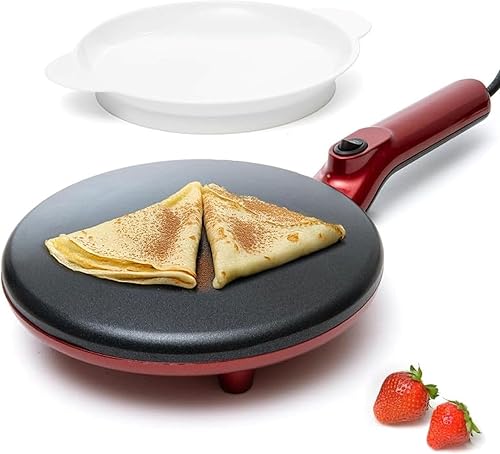
The Moss & Stone OZJONG delivers 800W of heating power for just $29.99, and its 4.2-star rating across 1,000 reviews confirms it punches well above its price. The 9 x 16-inch footprint suggests a cooking surface large enough for proper full-size crepes. Available in a red finish, it stands out on a countertop and runs on standard 120V, so there are no compatibility concerns for US buyers.
Best for: Budget-conscious buyers who still want enough wattage for real cooking sessions
Pros
Strong 800W output for the price, well above the 300W budget tier
1,000 reviews at 4.2 stars, strong buyer validation for a sub-$30 appliance
Standard 120V for plug-and-play use in any US home
9 x 16-inch footprint indicates a generous cooking surface for the price
Lightweight at 2.0 lb and easy to store
Cons
Fewer specs disclosed compared to higher-priced models, so exact plate diameter is not confirmed
Lower wattage than the top pick may mean slightly longer preheat times
Bottom line: At $29.99 with 800W and 1,000 reviews behind it, the Moss & Stone OZJONG is the strongest value pick on this list.
The SCS Direct crepe maker runs at 1,200W, the highest wattage on this list, and costs $39.99. Its 4.2-star average across 852 reviews shows consistent buyer satisfaction. It runs on standard 120V and lists a black and white finish. The 1,200W output means faster preheat and better heat recovery between crepes than most models at this price, which is a real advantage when cooking in batches.
Best for: Home cooks who want the most wattage for the price and plan to cook in batches
Pros
1,200W is the highest wattage on this list, delivering fast preheat and strong heat recovery
4.2 stars across 852 reviews at a $39.99 price point is solid performance
Standard 120V, no adapter needed for US kitchens
Mid-range price makes it accessible for regular home use
Good heat output for savory crepes and galettes that need consistent temperatures
Cons
Limited spec disclosures, exact plate diameter and material not confirmed in listing data
Slightly higher price than the Moss & Stone with a similar star rating
Bottom line: If wattage is your priority and you want to stay under $40, the SCS Direct at 1,200W is the pick.
The Starfrit crepe maker at $17.79 is the most affordable option on this list, with a 4.1-star average across nearly 900 reviews. It is compact at 6.4 x 4.9 x 3.1 inches and weighs under 1 lb at 0.93 lb, making it easy to tuck into a drawer. The plastic body and 300W output are clear trade-offs, but for a casual crepe maker who only fires it up occasionally, the price is nearly impossible to beat.
Best for: Occasional users and first-time crepe makers who want a low-risk entry point under $20
Pros
At $17.79, easily the most affordable crepe maker on this list
4.1 stars across 899 reviews, strong buyer satisfaction for the price tier
Ultra-lightweight at 0.93 lb and compact enough for small kitchens or dorm use
Standard 120V, plug-in ready for any US outlet
Good for occasional single-serving crepes without a big investment
Cons
300W is the lowest wattage on this list, meaning slow preheat and poor heat recovery during batches
Plastic build and small surface limit durability and cooking capacity versus higher-wattage models
Bottom line: Hard to beat at $17.79 for casual use, but the 300W ceiling will frustrate anyone cooking more than a crepe or two at a time.
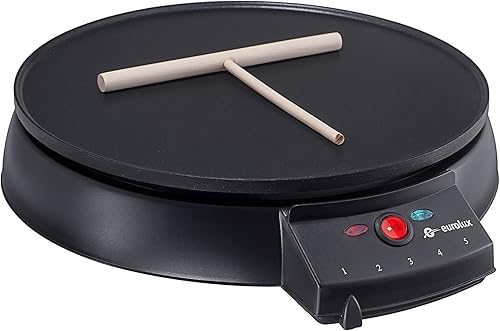
The Eurolux EL-1100 is an aluminum-body crepe maker priced at $29.95 with a 4.1-star average across 283 reviews. Aluminum plates heat more evenly than plastic-backed surfaces, which benefits crepe quality. It runs on standard voltage and represents a solid option for buyers who want a real aluminum cooking surface without spending more than $30. The smaller review pool compared to the top picks is worth noting, but the rating holds up.
Best for: Buyers who specifically want an aluminum cooking surface and want to stay near the $30 price point
Pros
Aluminum construction tends to distribute heat more evenly than plastic alternatives
4.1-star average across 283 reviews is consistent for its price bracket
Priced at $29.95, accessible for most budgets
Standard plug-in voltage, no adapter required for US buyers
Aluminum surface is generally more durable than lightweight plastic plates
Cons
Smaller review pool at 283 compared to higher-ranked picks, offering less buyer signal
Wattage and plate size are not disclosed, making direct heat comparisons difficult
Bottom line: The Eurolux EL-1100 is a solid aluminum-surface pick at $29.95, though the limited spec disclosure means you are buying partly on trust.
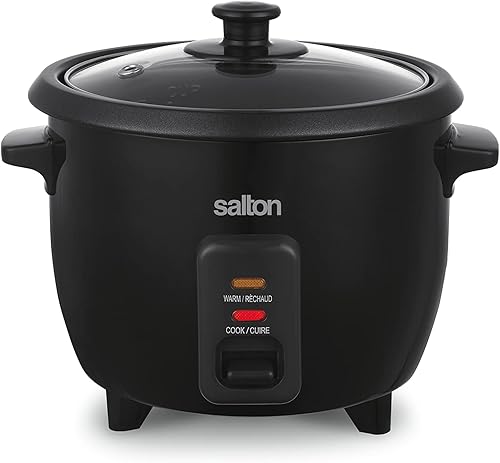
The Salton RC2104BK is an aluminum crepe maker with a 9.2 x 8.2 x 7.8-inch footprint and a 2.8 lb build that feels more substantial than the lighter budget options. It carries a 4.1-star rating across 122 reviews and is priced at $57.23. The aluminum construction and listed dimensions suggest a full-size cooking surface. At $57, it occupies the gap between the budget tier and the Severin, and the 115V rating means it works in standard US households without any adapter.
Best for: Home cooks who want a larger, more substantial aluminum crepe maker and are willing to spend in the $55 to $60 range
Pros
Aluminum body at 2.8 lb suggests a more substantial, durable build versus lighter plastic models
9.2 x 8.2-inch overall dimensions indicate a meaningful cooking surface for home use
115V rated, compatible with standard US outlets
4.1-star rating across 122 reviews at a mid-price point holds up for its tier
Sits between budget and premium pricing for buyers who want more build quality without spending $80
Cons
Smaller review count at 122 provides less buyer validation than top-ranked picks
At $57.23, it costs more than similarly-rated models with less proven track records
Bottom line: The Salton RC2104BK is a reasonable mid-range buy for its aluminum build and surface size, though buyers should weigh the smaller review pool.
The Waring WSC160X at $427 is built for a different use case than every other model on this list. With a 4.3-star rating across 136 reviews, it holds up well given that its buyers are predominantly food service operators or serious enthusiasts, a group that is typically harsher in its assessments. Commercial crepe makers use thicker, heavier cooking surfaces that hold and recover heat far more consistently than home appliances. If you are outfitting a small cafe, a catering setup, or a market stall, the Waring is the only model here that fits the job.
Best for: Small cafes, caterers, market vendors, or serious cooking enthusiasts who need commercial-level durability
Pros
4.3-star rating across 136 commercial-grade reviews carries real weight for a $427 appliance
Commercial construction means heavier, more consistent heat retention for batch production
Built for sustained, high-volume use that would wear out a home appliance quickly
Widely recognized brand in commercial food service equipment
The premium price reflects genuine commercial build quality rather than marketing
Cons
At $427, it is priced out of range for virtually all home buyers
Commercial units are heavier and less convenient for casual home storage and use
Bottom line: The Waring WSC160X is the right answer only if you need commercial output. For home use, the Severin at $80 is the better spend.
Crepe batter is thin and cooks fast, so surface temperature consistency is critical. A plate that heats unevenly leaves you with pale patches or scorched spots on the same crepe. Wattage is the simplest predictor of heating speed and recovery time between batches. The models on this list range from 300W on the Starfrit to 1,200W on the SCS Direct, with the Severin sitting at 1,000W. If you plan to make more than a few crepes in a row, aim for at least 800W. The Starfrit at 300W is fine for occasional single-serving use but will struggle to keep pace during a family breakfast. For anything resembling batch cooking, 1,000W or higher is the practical threshold.
Plate Size and Cooking Surface
Crepe diameter is limited by the plate, so plate size directly determines what you can make. A small 6-inch plate is fine for dessert crepes or single-person servings, while a larger 10-inch-plus surface opens up savory wraps and galettes. The Moss & Stone OZJONG lists its footprint at 9 x 16 inches, suggesting a cooking surface large enough for a proper full-size crepe. The Starfrit, at roughly 6.4 x 4.9 inches overall, is clearly in the compact category. When comparing models, look at the overall dimension listing and remember the usable cooking surface is always smaller than the unit footprint. If you plan to serve guests, a larger plate saves significant time and frustration.
Non-Stick Coating and Material
Non-stick coatings make or break the crepe experience because even a minor sticking issue ruins a delicate crepe. Aluminum plates with a dedicated non-stick layer, like the Eurolux EL-1100 and the Salton RC2104BK, generally perform well as long as you avoid metal utensils and abrasive cleaning. The Severin CM 2198 uses a plastic-and-non-stick combination that has clearly earned consumer trust given its 7,000-review base. Always use silicone or plastic spreaders when possible, and hand-wash the plate to extend the life of the coating. Replacing a coating that has flaked is not easy on a dedicated crepe maker, so proper care is worth the extra few minutes.
Voltage and Compatibility
Most American households run on 120V, so a crepe maker rated for 240V will not work without a step-up converter. The Severin CM 2198 is rated for 240V, which is worth double-checking before ordering if you are in the US. It has accumulated 7,000 reviews and remains widely sold, but buyers in North America need to confirm power compatibility or have a converter on hand. The SCS Direct model runs on standard 120V and the Moss & Stone OZJONG also lists 120V, making them plug-and-play for any US outlet. The Starfrit and Salton are both 120V or 115V, so no surprises there. When shopping, check the voltage spec in the product listing before purchasing.
Price Tiers and What to Expect at Each
You can spend anywhere from $17.79 to $427 on a crepe maker, and the use case changes significantly across that range. At the under-$20 level, the Starfrit delivers a compact, low-wattage plate that works for occasional use and tight budgets. The $29 to $40 band, represented by the Eurolux, Moss & Stone, and SCS Direct, is the sweet spot for everyday home use, offering 800W to 1,200W and decent surface sizes. The Severin at $80 is the premium home pick, with the highest rating and the largest review pool to back it up. The Waring WSC160X at $427 is a different category entirely, aimed at small cafes or serious cooking enthusiasts who need commercial durability and consistent output. Buy to match your actual use frequency, not aspirational cooking habits.
Common mistakes to avoid
Pouring batter onto a cold plate: always let the crepe maker preheat fully before adding batter, usually two to three minutes, otherwise the first crepe sticks and tears.
Using too much batter at once: crepes should be thin, so start with about two tablespoons for a small plate and adjust down from there rather than up.
Skipping a light oil coat: even non-stick surfaces benefit from a very thin layer of butter or oil on the first crepe, especially on a new plate.
Cranking heat too high: crepe makers have fixed or limited temperature controls, and exceeding the right range scorches the edges before the center cooks through.
Using metal utensils on non-stick coatings: metal spatulas scratch coatings fast, which leads to sticking and shortens the life of the plate considerably.
Buying 240V models without a converter for US use: the Severin CM 2198 is 240V, so US buyers need to verify their setup before plugging in.
Frequently asked questions
What is the difference between a crepe maker and a regular griddle?
A crepe maker is designed with a flat, low-profile plate that spreads heat evenly across a wide, shallow surface. Regular griddles often have raised edges or uneven heat zones that make it harder to pour and spread thin batter in a controlled circle. Dedicated crepe makers also tend to be shallower, which makes flipping easier with a spatula or wooden spreader. For occasional crepes, a flat griddle can work, but a dedicated plate gives you more consistent results with less practice.
Can I make pancakes on a crepe maker?
Yes, most crepe maker plates work fine for small pancakes since the cooking surface is flat and non-stick. The main limitation is size since the cooking area is typically designed for thin, wide crepes rather than thick, puffed pancakes. Expect smaller pancakes than you would get on a full griddle. The low-wattage models like the Starfrit at 300W will take longer to cook thick batter through, so higher-wattage models are a better choice if you plan to use the plate for both crepes and pancakes.
Is the Severin CM 2198 compatible with US outlets?
The Severin CM 2198 is rated at 240V, which is the European standard rather than the 120V standard used in most US homes. You can use it in the US with a step-up voltage converter, but that adds cost and bulk. Before buying, confirm your home outlet voltage and whether you need a converter. If you want a straightforward plug-in experience in North America, the SCS Direct at 120V or the Moss & Stone OZJONG are simpler options.
How do I keep crepes from sticking even on a non-stick plate?
Full preheat is the single biggest factor. A plate that is not hot enough causes batter to grip the surface before it can set. Beyond that, a very thin coating of butter or neutral oil on the first crepe helps season the surface, even if the plate is labeled non-stick. Spreading batter quickly and evenly with a wooden spreader also reduces the chance of uneven cooking that can cause tearing. Finally, use silicone or plastic tools, never metal, to protect the coating.
Which crepe maker is best for someone who wants to spend as little as possible?
The Starfrit (ASIN B0BT55R4HM) at $17.79 is the lowest-priced option on this list with a 4.1-star average across nearly 900 reviews, which is solid for the price tier. The trade-off is its 300W output, which is the lowest on the list and means slower preheat and lower sustained heat for back-to-back crepes. It makes sense for someone who wants to make a crepe or two occasionally and does not want to invest more. If you plan to make crepes even once a week, the Moss & Stone OZJONG at $29.99 with 800W is worth the extra $12.
What makes the Waring WSC160X worth its $427 price?
The Waring WSC160X is a commercial-focused unit built for heavier use than a typical home appliance. It carries a 4.3-star rating across 136 reviews, which is meaningful for a model at this price point since most buyers at $427 are investing seriously. Commercial crepe makers use heavier cast iron or thick aluminum plates that retain heat more consistently across large batches. The Waring is not the right choice for a home cook making crepes twice a month, but for a small cafe, a market stall, or a serious cooking setup where the plate runs for hours, the durability and consistent output justify the cost. Questions? Reach us at hello@chpizza.com.
Final recommendation
For most home cooks, the Severin CM 2198 at $80 is the clear answer, with the largest review pool in this category and a 4.6-star average that is hard to argue with. Buyers watching their budget will find solid value in the Moss & Stone OZJONG at $29.99 or the Starfrit at $17.79. If you need commercial-level durability, the Waring WSC160X is the only model here built for sustained, high-volume output. Match the wattage and voltage to your actual kitchen setup before ordering, and you will be making thin, even crepes from the first batch.
We use necessary cookies to keep the site working. With your permission, we also use functional, analytics, and marketing cookies. Read our Cookie Policy.