A bread machine does the hard work of mixing, kneading, proofing, and baking so you get a fresh loaf with almost no effort. The category runs from basic single-program machines under $100 to fully programmable units with 40-plus cycles pushing $500. Most home bakers land somewhere in the $100 to $200 range, where a handful of machines from Cuisinart, KBS, and Hamilton Beach have racked up tens of thousands of verified reviews. Wattage matters more than most buyers realize: machines under 500 watts can struggle to knead dense whole-wheat or multigrain doughs, while 650 to 710 watt motors handle them without complaint. Program count is worth checking too, since more cycles means the machine can handle jam, pasta dough, and gluten-free recipes in addition to standard white and wheat loaves. We ranked every model here by real buyer volume, verified star rating (nothing below 4.0 made the cut), and how much program depth and motor power you get per dollar.
Short answer: The Cuisinart CBK-110P1ES (B07C8V4FDR, $119.95) is the most-reviewed bread machine on Amazon with over 16,000 ratings at 4.4 stars, making it the safest all-around buy at this price. For pure spec value per dollar, the KBS MBF-014A (B0G3PYC22B, $129.99) edges it out with 20 programs and a 650-watt motor from a brand that also dominates with the long-running KBS MBF-010 (B07BYXHYLY, $129.99) and over 11,000 reviews.
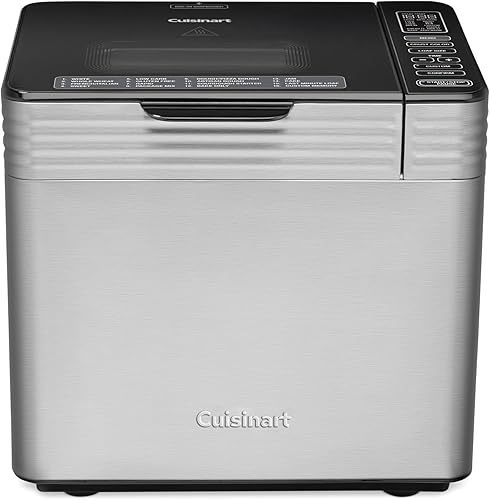
The Cuisinart CBK-110P1ES is the single most-reviewed bread machine in this roundup, with 16,794 ratings at 4.4 stars and a price of $119.95. It runs at 550 watts with 12 programs covering white, wheat, French, sweet, gluten-free, dough-only, and more. The stainless steel and plastic body measures 10.25 by 11.25 by 13.25 inches, which fits on most kitchen counters without dominating the space. The combination of massive buyer volume, a trusted brand, and an approachable price point makes this the lowest-risk purchase in the category.
Best for: Anyone who wants maximum buyer validation and brand reliability at under $120
Pros
16,794 reviews provides very strong buyer confidence
12 programs covers all everyday bread types
550 watts handles white and standard wheat breads well
Compact footprint at 10.25 x 11.25 x 13.25 inches
Cuisinart replacement parts widely available
Cons
550 watts can struggle with very dense whole-grain doughs
12 programs fewer than comparably priced KBS models
Bottom line: The most-reviewed bread machine at this price by a wide margin. Cuisinart's track record and parts availability seal the deal.
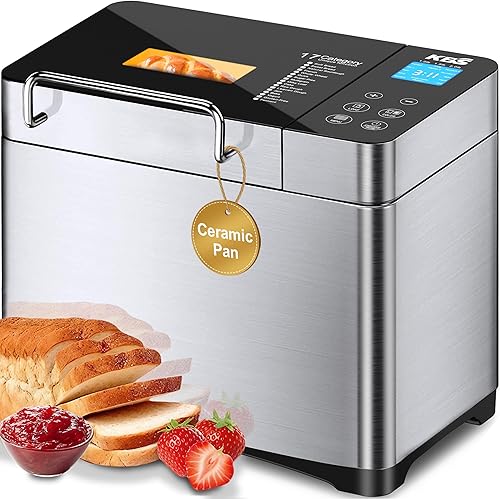
The KBS MBF-010 has 11,441 reviews at 4.4 stars, making it the second most-proven machine in this list, and its 710-watt motor is notably stronger than most competitors at $129.99. It offers 17 programs in a compact 9.76 by 13.58 by 12.21 inch footprint weighing 14.7 pounds. The silver stainless steel exterior holds up well to regular use. For buyers who want to bake multigrain or whole wheat loaves regularly, the extra motor power compared to 550-watt machines is a meaningful real-world advantage.
Best for: Whole wheat and multigrain bakers who want strong motor performance at a budget price
Pros
11,441 reviews at 4.4 stars is exceptional validation
710-watt motor is one of the strongest under $135
17 programs adds flexibility for specialty loaves
Compact dimensions at 9.76 x 13.58 x 12.21 inches
120-volt standard US plug
Cons
Brand parts availability not as established as Cuisinart
No wattage advantage matters less for white-bread-only bakers
Bottom line: More motor power and more programs than the Cuisinart at almost the same price. The 11,000-plus review count confirms it delivers.
The KBS MBF-014A offers 20 programs and a 650-watt motor at $129.99 with 5,300 reviews at 4.4 stars, which is an impressive spec-to-price ratio. It shares the same compact 8 by 13.4 by 11 inch dimensions as the MBF-010 and runs on 120 volts. Twenty programs is more than almost any machine under $200, covering standard breads plus gluten-free, jam, cake, and pasta dough cycles. The white stainless steel exterior looks clean on the counter and the review count has grown fast, suggesting this is quickly becoming KBS's flagship model.
Best for: Buyers who want the most program versatility per dollar spent
Pros
20 programs is best-in-class for this price range
650 watts handles denser doughs better than 550-watt machines
5,300 reviews at 4.4 stars shows strong adoption
Compact 8 x 13.4 x 11 inch footprint
120 volts, US-compatible
Cons
Newer model than the MBF-010, so long-term reliability data is still building
No listed weight makes it harder to assess portability before buying
Bottom line: Twenty programs and 650 watts at $129.99 is the strongest spec sheet for the money in this entire roundup.
The Amazon Basics BM1349-UL-B has 7,200 reviews at 4.3 stars and is currently in stock, offering 14 programs and 550 watts in a trim 11.6 by 8.8 by 11.4 inch black design weighing 8 pounds. Price was not available at time of publication, but the Amazon Basics line is consistently positioned at the lower end of the market and the 7,200 review count at a 4.3 rating means buyers are broadly satisfied. Fourteen programs covers all the basics plus gluten-free and jam without overwhelming new users with options.
Best for: First-time bread machine buyers who want a well-reviewed, no-drama starting point
Pros
7,200 reviews at 4.3 stars provides strong confidence
14 programs covers all common bread types including gluten-free
Lightweight at 8 pounds for a bread machine
Compact 11.6 x 8.8 x 11.4 inch footprint
Amazon Basics backing means straightforward return and support process
Cons
550 watts is adequate but not great for dense whole-grain doughs
Price not listed, check current Amazon pricing before purchase
Bottom line: Seven thousand verified reviews at 4.3 stars is a hard number to argue with. A safe, practical choice for everyday baking.
The BB-PDC20BA sits at $454.95 with 4,886 reviews at 4.6 stars, the highest average rating in this entire roundup, and 700 watts driving 7 programs. It measures 10.5 by 18 by 12.87 inches and weighs 24 pounds, making it the heaviest and widest machine here. The stainless steel and black finish looks premium on the counter. Seven programs is fewer than budget machines, but the programs are refined and the 4.6-star average from nearly 5,000 buyers signals consistently excellent results for the buyers willing to invest at this tier.
Best for: Buyers who bake frequently and want the best-rated machine without concern for price
Pros
4.6-star average is highest in this roundup
4,886 reviews is substantial validation for a premium price
700-watt motor handles dense doughs with ease
Stainless steel construction built for longevity
120-volt US-standard
Cons
Only 7 programs limits specialty-baking flexibility
24-pound weight and 18-inch depth makes it hard to move or store
Bottom line: The highest-rated machine in this list by buyer score. The price is real but so is the consensus that it delivers consistently better results.
This KBS machine comes in at $99.99 with 19 programs, a 650-watt motor, and 894 reviews at 4.5 stars. It measures 8 by 13.4 by 11 inches and weighs 12.4 pounds, running on 120 volts. Nineteen programs at $99.99 is genuinely unusual: most sub-$100 machines top out at 12 to 14 programs, and few reach 650 watts at this price. The 4.5-star rating from nearly 900 buyers suggests quality control is solid for the price tier, and the KBS ecosystem means accessories and support are available.
Best for: Budget-conscious buyers who do not want to sacrifice program flexibility
Pros
19 programs at under $100 is best-in-class for price
650 watts strong enough for most specialty doughs
4.5 stars from 894 reviews is very encouraging for a newer model
Compact 8 x 13.4 x 11 inch footprint
KBS brand with growing ecosystem of accessories
Cons
Under 1,000 reviews means less long-term reliability data than Cuisinart or KBS MBF-010
Black color shows fingerprints and flour dust more visibly
Bottom line: Nineteen programs and 650 watts at $99.99 beats machines costing $30 to $50 more on spec. Hard to beat at this price.
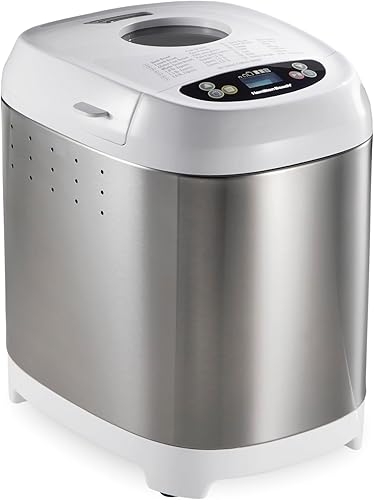
The Hamilton Beach 29987 is priced at $109.95 with 663 reviews at 4.4 stars, offering 14 programs and 550 watts in a 13.98 by 9.13 by 11.89 inch stainless steel and white body at 9.3 pounds. Hamilton Beach is a household brand with decades of small appliance history and broad retail availability, which means finding a replacement or making a return is straightforward. The white and stainless steel finish is one of the cleaner-looking designs in this price range.
Best for: Buyers who prefer established brick-and-mortar brands with easy in-store support
Pros
Hamilton Beach brand with wide retail and service support
663 reviews at 4.4 stars shows solid early adoption
14 programs covers all standard cycles
9.3 pounds is easy to move and store
$109.95 sits below most competitors with comparable programs
Cons
550 watts is adequate for white bread but not ideal for heavy whole-grain loaves
Fewer reviews than Cuisinart and KBS alternatives at similar price
Bottom line: Hamilton Beach reliability and $109.95 pricing make this a comfortable entry point, especially for buyers who shop at Target or Walmart.
The Culinary Chef CCBRM100-SSRED stands out with a red stainless steel finish that is genuinely uncommon in this category, which defaults to silver, black, and white. It has 964 reviews at 4.4 stars, priced at $142.99 with 15 programs and a 710-watt motor at 110 volts. Dimensions are 11 by 13 by 11 inches at 6.48 pounds, making it one of the lighter machines with a strong motor. The combination of high wattage, 15 programs, and distinctive styling at under $145 makes it worth considering if you want your bread machine to look like a deliberate design choice rather than an appliance you are hiding in a cabinet.
Best for: Bakers who want a countertop machine that looks intentional rather than purely functional
Pros
710-watt motor handles dense doughs effectively
15 programs gives solid versatility
Distinctive red stainless steel stands out from commodity designs
6.48 pounds is lightweight for the wattage
964 reviews at 4.4 stars shows real buyer satisfaction
Cons
Red finish is distinctive but not for everyone
$142.99 is a slight premium over KBS models with comparable wattage
Bottom line: Same 710-watt class as the KBS MBF-010 with a better-looking finish and nearly 1,000 satisfied reviews at under $145.
The Cuisinart CBK-200 at $237.99 steps up from the entry CBK-110P1ES with an 800-watt motor, 16 programs, and 481 reviews at 4.4 stars. The stainless steel body measures 12.25 by 8.85 by 13 inches and weighs 10.8 pounds at 120 volts. Eight hundred watts is the strongest motor wattage of any Cuisinart in this list, making it the right choice for buyers who want Cuisinart's brand reliability and replacement-part access but bake dense whole-grain loaves regularly. Sixteen programs also covers jam and pasta dough in addition to standard bread cycles.
Best for: Cuisinart loyalists who bake frequently with heavy doughs and want brand support
Pros
800-watt motor is best in Cuisinart's bread machine lineup
16 programs adds jam and pasta dough to standard cycles
Cuisinart brand with easily sourced replacement pans and paddles
Stainless steel construction at a reasonable 10.8 pounds
481 reviews at 4.4 stars with a trusted brand behind it
Cons
$237.99 is a noticeable step up from $129.99 KBS models with similar wattage
Fewer reviews than the CBK-110P1ES means less long-term reliability data
Bottom line: The best Cuisinart option if 550 watts is not enough and you want the brand's parts network behind you.
The SD-MDX4-K offers a remarkable 43 programs at $540 with 285 reviews at 4.5 stars, running on a 430-watt motor in a black metal 14.02 by 10.35 by 13.9 inch chassis at 6 pounds. Forty-three programs covers virtually every bread and dough scenario imaginable, from basic white to sourdough starter maintenance, rice bread, and multiple gluten-free variations. The 430-watt motor is lower than most machines on this list, which means the value proposition is in program depth rather than raw kneading power. Best for bakers who want maximum recipe control and are comfortable spending at the high end.
Best for: Dedicated bread hobbyists who regularly bake specialty and international bread recipes
Pros
43 programs is by far the most in this roundup
4.5 stars from 285 buyers is a solid rating for a specialty machine
Lightweight at 6 pounds for a machine this capable
Metal construction feels premium at this price
Covers sourdough, rice bread, and gluten-free variants standard machines skip
Cons
430-watt motor is lower than machines costing $100 to $200 less
$540 price requires heavy, frequent use to justify over mainstream alternatives
Bottom line: No other machine in this list comes close to 43 programs. If program depth is the priority and budget is flexible, this is the one.
Most bread machine listings lead with loaf size or program count, but motor wattage is the spec that separates machines that knead properly from ones that stall on whole wheat. Budget machines often run at 450 to 550 watts, which is fine for white bread made with all-purpose flour. Once you move to denser doughs like whole grain, multigrain, or rye, you want 650 watts or more. The KBS MBF-010 and MBF-014A both run at 650 to 710 watts and their combined 16,000-plus reviews suggest buyers are satisfied with the results. If you bake only white or light wheat bread, a 550-watt machine from Cuisinart or Hamilton Beach is completely adequate. Budget at least $120 for a reliable 550-watt unit and $130 to $145 for a step up to 650 to 710 watts.
Program Count: How Many Cycles Do You Actually Need?
Entry-level machines offer 5 to 12 programs covering basic white, wheat, French, quick, sweet, and dough-only cycles. That covers 90 percent of what most home bakers actually make. Machines in the 14 to 20 program range add gluten-free, jam, pasta dough, cake, and sometimes yogurt or sourdough starter cycles. The Cuisinart CBK-110P1ES gives you 12 programs at $119.95, which is enough for the majority of recipes. KBS machines in the same price band give you 17 to 20 programs. If you want specialized cycles without spending a premium, the KBS models win on program count per dollar. The SD-MDX4-K tops the list at 43 programs but costs $540, so the value math only works if you genuinely use the exotic settings.
Size and Loaf Capacity
Most countertop bread machines produce a 1.5 to 2 pound loaf, which feeds a small family for two to three days. The physical footprint matters as much as loaf size because these machines take up significant counter space. The KBS MBF-010 measures roughly 9.76 by 13.58 by 12.21 inches and weighs about 14.7 pounds, which is fairly typical. The BB-PDC20BA runs wider at 10.5 by 18 inches, making it one of the largest footprints in this roundup. If counter space is tight, look at smaller profiles like the Cuisinart CBK-110C at 8.5 by 11 by 11 inches and 8 pounds. Always measure your cabinet clearance before buying because the lid needs to open fully for you to add ingredients and remove the paddle.
Delay Timer and Keep-Warm Features
A delay timer lets you load ingredients at night and wake up to fresh bread in the morning. Most mid-range machines include a timer that allows 9 to 15 hours of delay, which is genuinely useful. The keep-warm function holds the loaf at temperature after baking finishes, typically for 60 minutes. Both features are standard on Cuisinart, KBS, and Hamilton Beach models in the $110 to $145 range. One important note: delay timer cycles should only be used with recipes that do not include dairy, eggs, or other perishables that can spoil at room temperature overnight. Stick to basic flour, water, yeast, salt, and sugar recipes when using the timer function.
Durability and the Bread Pan
The bread pan and its non-stick coating are the first things to wear out on any machine. Budget pans with thin coatings can start flaking within one to two years of regular use. Stainless steel exterior construction on machines like the Cuisinart CBK-200 and Culinary Chef CCBRM100 does not directly affect pan quality, but brands investing in better exterior materials often use better pans too. The kneading paddle will always leave a small hole in the bottom of your loaf, and every machine includes a hook tool to remove the paddle before the bake cycle begins if you prefer hole-free slices. Replacement pans and paddles are available for major brands like Cuisinart and are worth checking on availability before you commit to a less-common brand.
When to Spend More
Spending over $250 on a bread machine makes sense in two specific situations. First, if you bake more than four loaves per week and want a machine built for that kind of regular use, a higher-wattage unit with a heavy-duty motor justifies the cost over time. Second, if you want a horizontal loaf pan rather than the vertical pan most machines use, that feature is only available at the premium tier. Horizontal pans produce a loaf shaped like a standard sandwich bread, which slices more evenly. The BB-PDC20BA at $454.95 is the most-reviewed premium option here with 4,886 ratings at 4.6 stars, suggesting the spend-more crowd has voted with their wallets on that one.
Common mistakes to avoid
Adding ingredients in the wrong order: most machines require liquids first, then dry ingredients, with yeast last on top to prevent premature activation.
Using bread flour and all-purpose flour interchangeably without adjusting liquid ratios, which leads to dense or collapsed loaves.
Running the delay timer with eggs or milk in the recipe, which can sit at room temperature for hours and cause food safety issues.
Not measuring ingredients by weight when a recipe specifies grams, since volume measurements for flour vary widely depending on how it settles.
Forgetting to remove the kneading paddle before the bake cycle starts, leaving a large hole in the finished loaf that wastes part of each slice.
Opening the lid during the kneading or rising stages, which lets heat and humidity escape and can disrupt the rise enough to collapse the loaf.
Frequently asked questions
What is the most reliable bread machine for everyday use?
The Cuisinart CBK-110P1ES (B07C8V4FDR) has over 16,000 reviews at 4.4 stars, which makes it the most proven everyday machine at its price. It runs at 550 watts with 12 programs covering the most common bread types. Cuisinart replacement parts including the pan and paddle are widely available, which matters when you use a machine frequently. For buyers who want slightly more motor power for dense doughs, the KBS MBF-010 (B07BYXHYLY) at $129.99 with 710 watts and 11,441 reviews is an equally safe choice.
Is a more expensive bread machine worth it?
At the $100 to $150 range you get solid performance for white and wheat breads. Spending $200 to $250 typically adds a heavier motor, more programs, and better build quality on the pan. Above $400 you are mostly paying for brand reputation and, in some cases, a horizontal pan or very specific specialty programs. The BB-PDC20BA at $454.95 with 4,886 reviews and a 4.6 star rating is the clearest data point that some buyers find the premium tier worth it, but the Cuisinart and KBS machines in the $120 to $130 range satisfy the vast majority of home bakers.
Can a bread machine make gluten-free bread?
Yes, but only if the machine has a dedicated gluten-free program. Gluten-free doughs behave differently from wheat doughs: they do not rise the same way and require different timing. Machines with 14 or more programs, like the Amazon Basics BM1349-UL-B with 14 cycles, the KBS MBF-014A with 20 cycles, or the Hamilton Beach 29890 with 21 programs, include gluten-free settings. If gluten-free baking is a priority, specifically confirm a gluten-free cycle is included rather than assuming program count covers it.
How long does it take a bread machine to bake a loaf?
Most standard white or wheat bread programs take 3 to 4 hours from start to finish, including mix, knead, two rise cycles, and bake. Quick-bread cycles can finish in 1.5 to 2 hours by reducing rise time, but the texture is denser. French bread programs often run 3.5 to 4 hours. Whole grain cycles can run 3.5 hours or longer because of the extended knead time needed for heavy doughs. These times are consistent across most machines in this price range regardless of brand.
Does wattage really affect bread quality?
For light white breads, no: a 450 to 550 watt machine handles them without issue. Where wattage shows up is with denser doughs containing a high proportion of whole wheat, rye, or added seeds and nuts. A lower-wattage motor can struggle to fully develop the gluten in dense doughs, which results in a heavy or gummy loaf. Machines at 650 to 710 watts like the KBS MBF-010 (710W), KBS MBF-014A (650W), and Culinary Chef CCBRM100 (710W) have enough headroom to handle most specialty recipes without the motor straining.
What is the best budget bread machine?
The KBS model B0CT2KB6BF at $99.99 offers 19 programs and 650 watts with 4.5 stars from 894 reviews, making it the standout under-$100 option for the specs you get. The Hamilton Beach 29987 (B0CKWL77CW) at $109.95 is another solid choice at 4.4 stars from 663 reviews with 14 programs and 550 watts. The Cuisinart CBK-110P1ES at $119.95 costs a bit more but has far more reviews behind it if you want maximum buyer consensus for the money.
How hard is a bread machine to clean?
The bread pan and paddle are the only removable parts and both should be hand-washed rather than put in the dishwasher to preserve the non-stick coating. The interior of the machine should only be wiped down with a damp cloth since it cannot get wet. Residue from spills during the mix cycle can bake onto the heating element and create odors, so wiping after each use is good practice. Most bread machines take about five minutes to clean after a loaf, which is a significant advantage over cleaning a stand mixer bowl, dough hook, and proofing vessel separately.
Final recommendation
For most home bakers, the Cuisinart CBK-110P1ES at $119.95 is the straightforward choice: 16,000-plus reviews, 4.4 stars, 12 programs, and a trusted brand with available replacement parts. If you want more programs and a stronger motor for the same price, the KBS MBF-010 or MBF-014A at $129.99 each give you 17 to 20 programs and 650 to 710 watts at a small premium. Spend over $200 only if you bake very frequently or need specialty programs beyond what the mainstream machines cover. Questions? Reach us at hello@chpizza.com.
We use necessary cookies to keep the site working. With your permission, we also use functional, analytics, and marketing cookies. Read our Cookie Policy.