Vevor
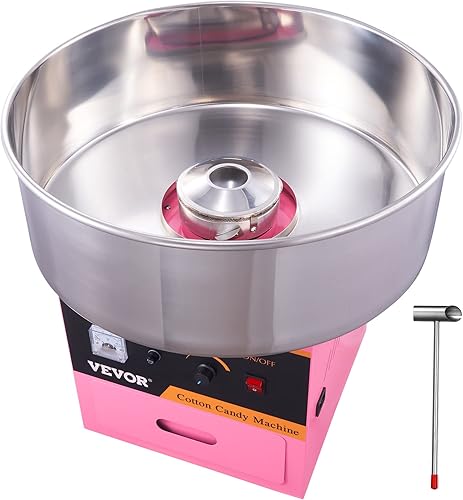
Vevor Electric Cotton Candy Machine, Cotton Candy Maker
$131.311,000+ bought last month
View on Amazon
Occasional home use, like birthday parties or holiday gatherings a few times a year, calls for a lightweight, easy-to-store unit. The Vevor MHTJJPXMO1-3S, for example, measures roughly 15 by 15 by 13 inches and weighs under 10 pounds, so it tucks into a cabinet between uses. If you plan to set up at school carnivals, farmers markets or community events on a regular basis, a cart-mounted machine makes setup and breakdown far faster. The Olde Midway COT2000 with cart bundle ($414.99) sits on a 36-by-36-inch rolling cart and tips the scale at 36 pounds, which is manageable for one person to wheel in from a vehicle but not something you want to carry up a flight of stairs. Think honestly about how often the machine will come out of storage before spending more than you need.
Cotton candy makers have a wide footprint because the spinning head flings sugar strands outward into a bowl or open floss area. Entry-level consumer units typically run 14 to 21 inches across, while commercial bowl machines can be 26 inches or wider. The Paragon 7105200, for instance, measures 26 by 26 by 20 inches and weighs 46 pounds, built from stainless steel and aluminum for durability in a concession environment. Measure your counter, table or cart space before buying, and factor in clearance around the unit so sugar strands do not stick to walls or nearby objects. A machine that looks compact in a product photo can still demand a surprisingly large clear zone during operation.
The cotton candy maker market divides pretty cleanly into three price bands. Budget units under $135 (like the Vevor Electric at $131.31 or the Vevor commercial-style at $99.90) attract the highest buyer volumes and carry hundreds of reviews, making them the safest starting point for anyone new to the category. Mid-range machines from $300 to $420 include cart packages or more robust construction aimed at semi-commercial use. Above $1,000, you are buying professional-grade builds like the Paragon 7105200 at $1,119.19, which makes sense for permanent concession stands but not for a home kitchen. In general, review count is a reliable proxy for reliability at each price point: the Vevor Electric at $131.31 has 772 reviews and a 4.4-star rating, which is strong evidence that the machine performs as described across a wide range of buyers.
If you ever need to carry the machine from a car to an event space, weight becomes a real practical concern. The compact Vevor MHTJJPXMO1-3S at 9.92 pounds is easy for one person to carry with one hand. The Winco CCM-28 at 24.25 pounds requires two hands and is a reasonable lift for most adults. The Paragon at 46 pounds and the Olde Midway cart bundle at 36 pounds both benefit from rolling storage or a permanent spot. Heavier machines often have more durable motors, but that durability matters most only if you are running the machine continuously for hours. For occasional home events, the lightest option that meets your bowl size is usually the right call.
A 5.0-star rating on a product with only two reviews is almost meaningless. The Winco CCM-28 scores a perfect 5.0, but with just two reviews that number could flip dramatically after a handful more buyers weigh in. Contrast that with the Vevor Electric at 4.4 stars across 772 reviews, which reflects a much more stable signal. A good rule of thumb is to require at least 50 reviews before relying on the star rating as a real indicator of quality. The Olde Midway cart bundle (4.3 stars, 70 reviews) and the Paragon (4.0 stars, 63 reviews) both clear that bar. When a product has fewer reviews, read the written comments carefully rather than anchoring on the average score.
Cotton candy machines require cleanup after every use because caramelized sugar hardens quickly and bonds to spinning heads and bowl surfaces. Machines with removable spinning heads and bowl components make this far easier. Stainless steel and aluminum surfaces, like those on the Paragon 7105200, wipe down with warm water and are resistant to staining. Plastic bowls common on consumer-grade units can discolor over time but are often lighter and cheaper to replace. Check whether replacement parts and extra floss sugar are readily available for the model you choose. A machine that is difficult or expensive to maintain will spend more time in the back of a cabinet than on your counter.
For home use, a budget of $85 to $135 covers well-reviewed options with strong buyer demand. Units in that range, like several Vevor models with hundreds of reviews and 4.2 to 4.4-star ratings, handle birthday parties and casual gatherings without the bulk or cost of commercial equipment.
A mid-size consumer unit in the 20 to 22-inch diameter range can keep up with a crowd of that size if you allow a few minutes between batches. For faster continuous output at events over 50 people, a cart-mounted machine with a larger spinning head is worth the extra cost and storage space.
Cleanup is manageable if you do it while the sugar is still warm and soft. Let the machine cool slightly, then wipe the spinning head and bowl with a damp cloth or warm water. Stainless steel and aluminum surfaces clean more easily than plastic. Avoid submerging electrical components in water.
Most machines are designed for pre-flavored floss sugar, also called floss sugar or fairy floss sugar, not regular granulated table sugar. Using plain table sugar can clog the spinning head and produce poor results. Check the manufacturer recommendations for your specific model before buying supplies.
Not necessarily. Heavier machines like the Paragon 7105200 at 46 pounds use stainless steel and aluminum construction suited for high-volume concession environments. For home use, a lighter unit under 25 pounds is usually sufficient and much easier to store and transport. Weight reflects the intended duty cycle, not quality in absolute terms.

