Convection Oven Cooking Time Adjustments: A Plain-English Guide
Convection ovens cook faster than conventional ovens, and a few simple rules let you use any standard recipe without guesswork.
If you switched to a convection oven and your first batch of cookies came out dark on the bottom after the normal time, you are not alone. Convection fans circulate hot air around the food, which speeds up browning and heat transfer compared to a still conventional oven. That means you need to either lower the temperature, cut the time, or both. Once you know the two main adjustment methods and which foods benefit most, the process becomes second nature.
Products mentioned in this post


Why Convection Cooks Faster
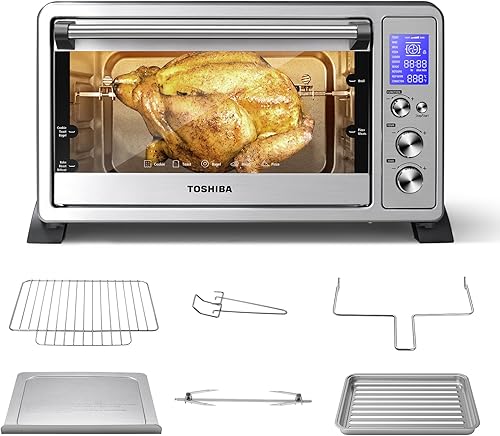
A standard oven heats the air inside the cavity and leaves it mostly still. A convection oven adds a fan that keeps that hot air moving continuously. Moving air strips away the cooler boundary layer that naturally forms around food, delivering heat more directly and evenly. The result is faster browning, crisper exteriors, and more consistent cooking from rack to rack. On a countertop model like the Toshiba AC25CEW-SS, which draws 1500 watts and tops out at 450 degrees F, that fan makes a real difference even in a small cavity. Understanding this mechanism helps you predict how much faster any recipe will cook.
The Two Adjustment Methods
There are two accepted approaches to adapting a conventional recipe for convection. The first is to reduce the oven temperature by 25 degrees F and keep the cook time the same. If a recipe calls for 375 degrees F for 30 minutes, set the convection oven to 350 degrees F and check at 30 minutes. The second method is to keep the original temperature and reduce the cook time by about 25 percent. At 375 degrees F for 30 minutes, you would start checking around the 22-minute mark. Both approaches work, but the temperature-reduction method is more forgiving for delicate baked goods, while the time-reduction method suits roasted vegetables and meats where you want a good crust.
Foods That Benefit Most from Convection
Convection shines on foods where surface browning and crispness matter. Roasted vegetables, chicken pieces, and sheet-pan dinners all come out with better color and texture. Cookies spread less and brown more evenly across the whole pan. Pastries and pies get crispier bottom crusts. Pizza crust firms up faster than it does in a still oven. If you use a convection oven for a pizza, expect the crust to set noticeably quicker, so watch the cheese rather than the clock.
Foods Where You Should Be Careful
Convection is not ideal for everything. Delicate custards, cheesecakes, and souffles can cook unevenly or develop cracked surfaces if the fan dries them out too fast. Light batters, like angel food cake, can be pushed to one side by the airflow before they set. Quick breads and muffins can form a tough crust before the interior finishes cooking. For these, either turn the convection fan off if your oven allows it, reduce the temperature by 25 degrees F and watch closely, or shield the top loosely with foil partway through. Many countertop convection ovens, such as the Chefman RJ50-15T rated 4.3 stars across more than 3,700 reviews, include a conventional bake mode for exactly this reason.
Rack Position Matters Less, But Still Matters
One of the advantages of convection is that rack position is less critical than in a conventional oven, because the fan equalizes temperatures. You can bake two sheet pans at once without rotating them halfway through, which is a genuine time saver. That said, placing food near the top of the oven will still produce more browning from above, and placing it near the bottom speeds up crust formation on the underside. For a standard roast or a tray of vegetables, the middle rack remains the safest default.
Using a Thermometer to Verify Doneness
Because convection shortens cooking times, a visual check is not always reliable. Meat can look done on the outside while the interior has not reached a safe temperature. An instant-read thermometer is the most direct way to know when a roast, chicken, or casserole is actually finished. For baked goods, the toothpick test and the spring-back test on cakes remain the simplest checks. Once you have cooked a particular dish in convection mode a few times and noted the adjusted time, you will rarely need to guess again.
Practical Starting Points for Common Dishes
As a starting point, roasted vegetables at 400 degrees F conventional usually work at 375 degrees F convection and are ready in about the same time. A whole chicken at 425 degrees F conventional often finishes at 400 degrees F convection 10 to 15 minutes sooner per pound. Sheet-pan cookies at 350 degrees F conventional can drop to 325 degrees F convection with the same time, or stay at 350 degrees F and finish 5 minutes early. Frozen pizza instructions typically assume a conventional oven, so subtract 5 to 10 minutes and check often. Write your adjustments in the margin of the recipe the first time you cook it, and future batches require no recalculation.
Frequently asked questions
Do I always have to adjust both time and temperature in a convection oven?
No. Adjust one or the other, not both at the same time. Reducing temperature by 25 degrees F with the same time is the simpler approach for most baked goods. Cutting time by 25 percent at the same temperature works well for roasted meats and vegetables. Doing both at once risks undercooking.
Can I use a convection oven for everything I bake?
Most savory dishes and many baked goods do well in convection. The exceptions are items that need a moist, gentle environment to set properly, like cheesecakes, custards, and souffles. For those, switch to a conventional bake mode if your oven has one, or tent loosely with foil and keep a close eye on them.
Why does convection cooking make cookies spread less?
The moving hot air sets the outer edge of the cookie faster than still oven heat would. When the edge sets quickly, the cookie has less time to spread before the structure firms up. The result is a slightly puffier, more evenly browned cookie compared to one baked in a conventional oven.
Does the size of the convection oven cavity change how much I need to adjust times?
A small countertop convection oven can concentrate heat more intensely around food than a large one, so the adjustment may need to be slightly larger in a compact model. Start with the standard 25 degree F or 25 percent rule, check early, and adjust from there based on your specific oven.
How do I know if my convection oven is actually working correctly?
Place a sheet of parchment on a rack, set the oven to 350 degrees F, and bake a single layer of sugar cookies for the package time. If they brown evenly across the whole sheet, the fan and heating element are working together properly. Uneven browning on a single pan usually points to a fan or heating issue, not your recipe.