Convection Oven Temperature Conversion Made Simple
A single rule covers most convection cooking situations, but knowing when to break it saves you from dry chicken and sunken cakes.
Convection ovens move hot air around the food with a fan, which means heat reaches the surface faster and more evenly than it does in a conventional oven. That speed is an advantage, but only if you account for it. Most recipes are written for conventional ovens, so using them as written in a convection oven leads to food that is overcooked on the outside and sometimes undercooked in the center. The fix is straightforward once you understand the two adjustments available to you: lower the temperature, reduce the time, or do both.
Products mentioned in this post


The Standard Rule: Drop 25 Degrees
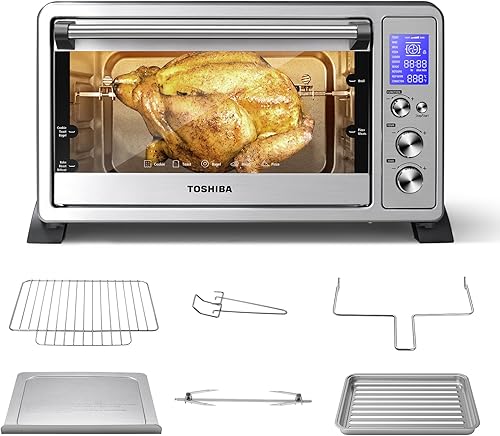
The most widely used conversion is to reduce the temperature by 25 degrees Fahrenheit and keep the cook time the same. If your recipe calls for 375F in a conventional oven, set your convection oven to 350F. This works well for roasted vegetables, meats, and most casseroles. It is a reliable starting point that accounts for the extra efficiency the fan provides without requiring you to watch the clock differently. Many countertop convection ovens, including models that top out at 450F like the Toshiba AC25CEW-SS and the Elite Gourmet ETO-4510M, have enough range to hit the adjusted target temperature for virtually any home recipe.
The Alternative: Cut the Time by 25 Percent
Instead of lowering the temperature, some cooks prefer to keep the original temperature and reduce the cook time by about 25 percent. This approach works well for foods where you want a browned or crisped exterior, such as roast chicken, pork tenderloin, or sheet-pan potatoes. The higher heat promotes surface browning while the shorter time keeps the interior from drying out. If you go this route, start checking for doneness at the 75 percent mark and use a thermometer for proteins. For a recipe that normally takes 40 minutes at 400F, plan to check around 30 minutes when you keep the temperature at 400F in convection mode.
When to Use Both Adjustments
For foods with long cook times, like a whole roast or a dense bread loaf, combining both adjustments is often the safest approach. Drop the temperature by 25 degrees and check 15 to 20 minutes earlier than the recipe suggests. Long-cooking items have more time to overcook, so the compound benefit of cooler heat and a shorter window reduces risk. Pay attention to color cues as well: convection browning happens faster, so if the surface looks done while the center is still cool, tent it loosely with foil for the remainder of the cook.
Baked Goods Need Special Attention
Cakes, muffins, quick breads, and soufflés are the exception to the standard rule. These items rely on a gentle, even rise, and the fan in a convection oven can push the batter around before it sets, leading to uneven tops or collapsed centers. For delicate baked goods, lower the temperature by 25 degrees but do not reduce the time, and check earlier than usual just in case your oven runs on the efficient end. Cookies and biscuits, on the other hand, benefit from convection because they are sturdy enough to handle the airflow and come out with a more even color across the entire pan. If your oven has a true European convection setting with a third heating element, the effect is stronger and you may need to drop a full 50 degrees for sensitive items.
Know Your Oven Before You Commit
Not all convection ovens perform identically. A 1750W unit like the Chefman RJ50-15T will heat and cycle differently than a smaller 1500W model, and older models may have fans that run slower than newer designs. The first time you use a new convection oven, bake or roast something familiar so you can compare the result to what you expect. An oven thermometer placed inside the cavity will tell you how close the actual temperature matches the dial setting, which matters because a convection oven that runs 15 degrees hot calls for a larger adjustment. Once you know how your specific oven behaves, the conversion becomes second nature.
Practical Conversion Examples
Here are common temperature conversions to keep handy. Conventional 325F becomes convection 300F. Conventional 350F becomes convection 325F. Conventional 375F becomes convection 350F. Conventional 400F becomes convection 375F. Conventional 425F becomes convection 400F. If you prefer the time-reduction approach, those same temperatures stay the same and you trim roughly one quarter off the cook time. Either method gets you to the right result for most savory cooking. Write your most-used conversion on a sticky note inside a cabinet door and you will never have to look it up again.
Frequently asked questions
Do I always need to convert temperatures when using a convection oven?
Yes, in almost every case. Convection ovens cook faster because the fan circulates hot air directly around the food, eliminating the cooler air pockets that form in a conventional oven. Using the original temperature and time from a conventional recipe will typically result in overcooked or dried-out food. The exception is if your recipe was already written for convection.
Should I lower the temperature or reduce the time, not both?
For most everyday cooking, pick one and stick with it. Lowering the temperature by 25 degrees is simpler because you do not have to reset a timer mid-recipe. Reducing the time while keeping the temperature works better when you want a browned crust on meats or vegetables. Using both adjustments at once risks undercooking, so reserve that approach for very long cook times where a small buffer is welcome.
Why did my cake fall in the convection oven even though I lowered the temperature?
The fan is likely the culprit. Gentle batters can be disturbed by airflow before the structure sets, causing uneven rise or collapse in the center. Some ovens let you turn the fan speed down or off, which solves the problem. If yours does not, stick to conventional mode for layer cakes and delicate quick breads and use convection only for sturdier baked goods.
Does a higher-wattage convection oven need a bigger temperature adjustment?
Wattage mainly affects how quickly the oven reaches the set temperature, not necessarily how much hotter it runs during cooking. The 25-degree rule applies regardless of wattage. What matters more is whether your specific oven tends to run hot, which you can check with an inexpensive oven thermometer placed on the center rack.
Can I use a convection oven for every recipe?
Most savory recipes translate well to convection with a simple temperature or time adjustment. The categories where conventional mode is often better include custards, cheesecakes, bread puddings, and any recipe where a cracked or browned top is unwanted. For everything else, roasts, sheet-pan meals, cookies, and reheating, convection gives you a better result in less time.