Do Toaster Ovens Use a Lot of Electricity?
Toaster ovens draw far less power than a full-size oven, but wattage varies widely across models and the difference adds up over time.
Most toaster ovens run between 650 and 1800 watts, which puts them well below the 2,000 to 5,000 watts a standard range oven pulls. Whether that translates to real savings depends on how long you run the appliance and what you are cooking. A compact model used for 20 minutes of toast a day costs only a few dollars a year in electricity. A large convection toaster oven running an hour a day will cost noticeably more, though still less than a full oven doing the same job.
Products mentioned in this post


What Wattage Do Toaster Ovens Actually Use?
Small personal-size toaster ovens typically land between 650 and 1000 watts. Mid-size models for a family of two or three usually pull 1200 to 1500 watts. Full-featured countertop ovens with convection or air-fry modes commonly reach 1700 to 1800 watts. The Elite Gourmet ETO236, a compact single-rack unit, is rated at 650 W, while the Hamilton Beach 31344DA sits at 1200 W and the Cuisinart TOB-1010NAS draws 1800 W. Those three numbers give you a clear sense of the range across price tiers.
How to Calculate What You Actually Pay
The math is straightforward. Multiply wattage by hours of use to get watt-hours, then divide by 1000 to convert to kilowatt-hours (kWh). The national average electricity rate in the U.S. is around 16 cents per kWh. A 1200 W toaster oven running 30 minutes a day uses 0.6 kWh, which costs about 10 cents per day or roughly $3 a month. A 1800 W model on the same schedule uses 0.9 kWh per day, around 14 cents, or about $4.20 a month. Your actual rate may be higher or lower depending on where you live.
Toaster Oven vs. Full Oven: The Real Gap
A standard electric wall oven or range element draws between 2,000 and 5,000 watts at full power, though it cycles on and off to maintain temperature. Still, for tasks like reheating a portion of leftovers, roasting a small cut of vegetables, or baking a couple of cookies, a toaster oven does the same job with a fraction of the draw. The energy savings are most meaningful when you replace regular full-oven sessions with the countertop unit rather than running both. Preheating time also matters: a toaster oven typically reaches temperature in 5 to 10 minutes, while a full oven can take 15 to 20.
Which Models Are More Efficient?
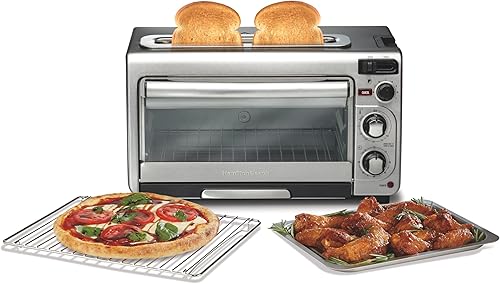
Lower wattage is not automatically better because it can mean slower or uneven cooking, which extends run time and partly cancels out the savings. The Hamilton Beach 31344DA at 1200 W, rated 4.4 stars across 9,100 reviews and priced around $59.95, strikes a reasonable balance for a compact unit. The Hamilton Beach 31156 at 1450 W, with 10,000 reviews and a 4.4 rating at about $99.95, adds a bit more capacity and speed without jumping to the 1800 W tier. Very small models under 700 W are best suited to one or two slices of toast and not much else.
Does Convection Mode Use More Power?
Convection adds a fan but the fan motor draws only a small amount of extra power, often 20 to 50 watts. The real benefit is that circulating air cooks food faster at a lower temperature setting, which can actually shorten total run time. So a 1800 W convection oven running 25 minutes may use less total energy than the same oven in standard mode running 35 minutes to achieve the same result. The net effect on your bill is usually neutral to slightly positive when you use the convection setting correctly.
Tips to Keep Toaster Oven Costs Low
Choose a model sized to what you actually cook. A 0.2 cu ft unit is plenty for toast and a single serving; a 0.6 cu ft model handles a 12-inch pizza or a small roast. Avoid preheating longer than needed, most models signal when they are ready. Unplug the unit when not in use if it has a clock or display that draws standby power, typically 1 to 3 watts around the clock. Batch small cooking tasks together when possible so you heat the cavity once rather than multiple short sessions.
Bottom Line on Electricity Use
Toaster ovens are not high-drain appliances in absolute terms. Even a 1800 W unit used for 45 minutes a day costs under $6 a month at average U.S. rates. The real payoff is replacing full oven use for small tasks, which can save a meaningful amount over a year. If energy efficiency is your primary concern, look at models in the 1000 to 1500 W range that still offer enough interior space for your cooking needs.
Frequently asked questions
How many watts does a typical toaster oven use?
Most consumer toaster ovens fall between 1200 and 1800 watts during active cooking. Compact single-rack models can be as low as 650 to 800 watts, while large countertop convection units often land at 1800 watts. The wattage rating on the label reflects peak draw, and the appliance cycles or dims elements during the hold phase.
Is it cheaper to use a toaster oven or a microwave?
Microwaves are generally faster, which often means lower total energy per task. A microwave reheating leftovers in 3 minutes at 1000 watts uses far less than a toaster oven doing the same in 10 minutes at 1500 watts. That said, toaster ovens produce better texture for crisping or browning, so the right choice depends on what you are making, not just the watt count.
Does leaving a toaster oven plugged in waste electricity?
A basic mechanical-dial model with no clock draws essentially zero standby power when off. Models with digital displays, clocks, or keep-warm modes can pull 1 to 3 watts continuously. At 16 cents per kWh, 3 watts of standby around the clock adds up to about 42 cents per month. It is a small amount, but unplugging between uses eliminates it entirely.
Will a toaster oven raise my electric bill noticeably?
At normal usage levels of 20 to 45 minutes a day, a toaster oven adds roughly 2 to 6 dollars per month to the average electric bill. That increase is often more than offset by reduced full oven use, which is a much larger draw. Most households see their total kitchen energy cost stay flat or decline when they adopt a toaster oven for everyday small tasks.
Does higher wattage mean the toaster oven cooks better?
Higher wattage generally means faster preheat and more responsive temperature recovery when you open the door. It does not automatically mean better results, since element placement, interior size, and heat distribution matter just as much. A well-designed 1500 W model can outperform a poorly designed 1800 W unit for even browning and consistent baking.