2-Slice vs 4-Slice Toaster: Which One Is Right for You?
Recommended picks

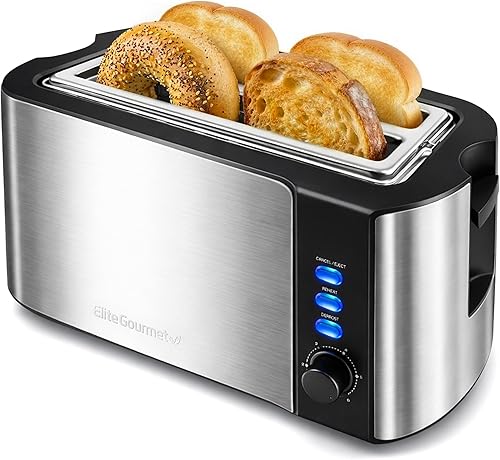

The Core Difference: Capacity and Footprint
The slot count determines how much bread you can toast in a single cycle and how much counter real estate the appliance claims. A typical 2-slice toaster sits around 10 to 11 inches long and 6 to 7 inches wide, making it easy to tuck under a cabinet. A 4-slice model adds a second pair of slots and stretches to roughly 14 to 16 inches in length, sometimes more. The Elite Gourmet ECT-3100, a 4-slot stainless steel toaster priced at $34.99, measures 14.68 inches long compared to the roughly 11-inch footprint of a comparable 2-slice unit. That extra length is the trade-off for doubling your throughput.
Wattage and Speed
More slots generally means higher wattage because both pairs of elements run simultaneously. Budget 2-slice toasters often land in the 750 to 900 W range. The Amazon Basics KT-3680, a highly rated 2-slice model with over 41,500 reviews and a 4.3-star average, draws 900 W and sells for just $22.04. Step up to a 4-slice or a higher-output 2-slice and wattage can hit 1300 W to 1800 W, as seen on the Cuisinart CPT-180P1 (1800 W, $59.95, 27,500 reviews, 4.3 stars). Higher wattage does not necessarily mean faster toasting per slice, but it does mean you can run four slots without a power dip that slows the cycle.
Who Should Buy a 2-Slice Toaster
A 2-slice toaster fits one to two people who eat breakfast at different times, dorm rooms, studio apartments, and anyone who is strict about counter clutter. The smaller body is easier to store in a cabinet when not in use. At the entry level, lightweight plastic-body options like the Elite Gourmet ECT1027B weigh about 1 pound and run at 750 W, so they barely register on your electricity bill. If you toast one to two pieces a day, you will never feel the capacity limit.
Who Should Buy a 4-Slice Toaster
Families of three or more, anyone who hosts weekend brunches, and households where people want toast on the table at the same time should strongly consider 4-slice. Two slots toasting two rounds back-to-back takes roughly twice as long, which adds up when everyone is standing in the kitchen waiting to eat. A 4-slot model eliminates that bottleneck in one cycle. The wider footprint also opens up usable slots for bagels, English muffins, and thick artisan slices that need extra room.
Price and Value
You typically pay $5 to $20 more for a 4-slice version of any given brand's lineup, though budget options exist at the low end. The Elite Gourmet ECT-3100 sits at $34.99 for a 4-slot metal-body toaster with 42,000 reviews and a 4.3-star rating, which is one of the better value propositions in the category. A mid-range 2-slice like the Cuisinart CPT-180P1 at $59.95 actually costs more than many 4-slot budget models, so price alone should not drive the decision. Match capacity to your household size first, then compare prices within that group.
Counter Space and Practical Fit
Before buying either type, measure the open counter run where the toaster will live. Allow at least two inches of clearance on each side for heat venting, and account for the cord length reaching your nearest outlet. A 4-slice model placed near a cabinet hinge or a coffee maker can feel crowded fast. If counter space is genuinely tight, a compact 2-slice is often the more livable choice even if you occasionally wish you had more slots. Some 4-slice models also come in a long narrow configuration that minimizes depth, so check both length and depth dimensions before buying.
Common mistakes to avoid
- Buying 4-slice out of habit when only one or two people eat toast, leaving half the slots idle every morning.
- Ignoring the footprint dimensions and discovering the toaster does not fit the intended counter spot after it arrives.
- Assuming higher wattage always means faster toasting. Slot size, heating element quality, and shade settings matter more than raw wattage.
- Choosing on price alone. A cheap 4-slice toaster may toast unevenly on the inner slots if the elements are underpowered.
- Overlooking crumb tray size. A 4-slice model collects crumbs twice as fast, so a removable, full-width tray makes a real difference in daily cleaning.
- Not checking slot width before buying. Standard slots handle regular sandwich bread, but bagels, thick sourdough, and artisan loaves need extra-wide slots regardless of whether you pick 2-slice or 4-slice.
Frequently asked questions
Does a 4-slice toaster toast faster than a 2-slice?
A 4-slice toaster does not make each individual slice toast faster. It toasts four pieces in the same time a 2-slice takes to do two, so the throughput per cycle doubles. If your household regularly needs four pieces at once, that is the real time savings.
How much more counter space does a 4-slice toaster take up?
Expect a 4-slice toaster to run three to five inches longer than its 2-slice counterpart, typically 14 to 16 inches versus 10 to 11 inches. Depth and height are usually similar between the two formats. Measure your available counter run before buying.
Is a 4-slice toaster worth it for a couple?
For two people eating at the same time, a 2-slice is usually enough since one cycle handles both servings. A 4-slice starts to make sense if you regularly have guests over for breakfast or if you also want to warm bagels and toast bread simultaneously without waiting for a second cycle.
Do 4-slice toasters use a lot more electricity than 2-slice?
Yes, but the absolute cost is still minor. A 2-slice model at 900 W and a 4-slice model at 1300 W to 1800 W both run for only one to three minutes per cycle. The difference in electricity cost per use is fractions of a cent, so power draw should not be a deciding factor for most households.
Can I use only two slots on a 4-slice toaster?
Most 4-slice toasters let you use just the left or right pair of slots independently. Some models require you to use all four slots or the heating elements run inefficiently and toast unevenly on the active pair. Check the product instructions or reviews to confirm independent slot control before buying.