How to Choose a Toaster
Recommended picks

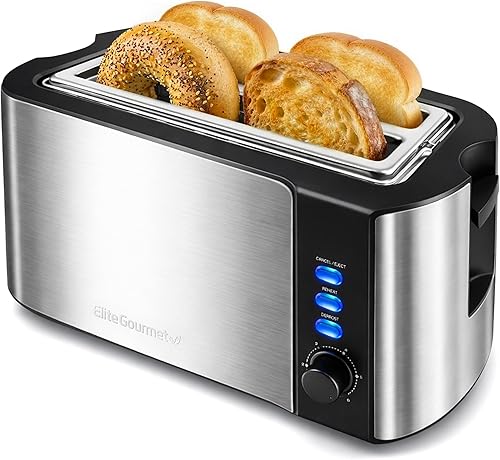

2-Slot vs. 4-Slot: Match the Toaster to Your Household
A 2-slot toaster takes up roughly half the counter space of a 4-slot and costs noticeably less upfront. If your household makes one or two pieces at a time, a 2-slot is the smarter buy. Families of four or more, or anyone who hosts weekend brunches regularly, will appreciate the doubled output of a 4-slot without having to run two batches. The Elite Gourmet ECT-3100, for example, is a 4-slot model at $34.99 with over 42,000 ratings at 4.3 stars, which points to broad satisfaction across households of all sizes. Before choosing, measure your counter and cabinet clearance, because a 4-slot unit can run 13 to 15 inches wide, noticeably larger than a compact 2-slot.
Wattage and Toasting Speed
Wattage tells you how fast the heating elements work. Most home toasters fall between 700 W and 1800 W. A 700 W to 900 W unit toasts fine but takes a few extra seconds per cycle, which adds up if you make multiple rounds. Higher-wattage models like the Cuisinart CPT-180P1 at 1800 W and $59.95 push heat more aggressively, which some people find produces a crisper outside with a softer center. For occasional use, anything in the 800 W to 900 W range, such as the Amazon Basics KT-3680 at 900 W and $22.04, is plenty. If you want faster cycles every morning, look for 1300 W or above.
Shade Settings and Functions
Shade settings let you dial in how dark your toast comes out, so this number matters more than most buyers realize. Six or seven settings give you fine enough control to land on your preferred level consistently, while a single-function toaster is an all-or-nothing proposition. Beyond shade, look for a bagel mode, which heats only the cut face, and a cancel button that stops the cycle mid-toast. A reheat or defrost function is genuinely useful if you pull frozen waffles or bread directly from the freezer. The Amazon Basics KT-3680 packs 6 functions into a $22.04 unit, while the Elite Gourmet ECT-3100 keeps things simpler with 3 functions at $34.99, which is enough for straightforward daily use.
Slot Width and What Fits
Standard slots handle regular sandwich bread and thin bagel halves without trouble. Wide slots are built for thick artisan bread, oversized bagels, and Texas toast, which can be up to an inch thick and simply will not lower into a standard slot. If you buy specialty bread from a bakery or bake your own thick loaves, narrow slots will frustrate you fast. Check the slot opening measurement in the product specs if the listing includes it, or look for the phrase 'extra-wide' or 'wide slots' in the model name. For most people buying sandwich bread from the grocery store, standard slots are fine.
Material and Build Quality
Plastic-body toasters cost less and are lighter, but brushed or polished stainless steel holds up to daily cleaning better and does not discolor over time. The Cuisinart CPT-180P1 uses stainless steel construction and weighs 6.1 pounds, which gives it a stable, planted feel on the counter. Lighter plastic models like the Elite Gourmet ECT-1027B at just over 1 pound can slide on a smooth countertop when you push the lever down. A removable crumb tray is not optional; every toaster should have one to keep crumbs from burning on the heating elements and creating smoke. Check that the tray slides out fully and is easy to clean before you buy.
Price and What to Expect at Each Level
Under $25 gets you a reliable 2-slot toaster with basic shade control and a crumb tray, nothing more. The $25 to $50 range adds better build quality, more functions, and often a wider slot. Above $50, you are mostly paying for stainless construction, higher wattage, a larger footprint, and brand reliability backed by a longer warranty. The Cuisinart CPT-180P1 at $59.95 represents a solid step up with 1800 W and 27,500 ratings at 4.3 stars. Spending more than $60 on a standard pop-up toaster for a home kitchen is rarely necessary unless aesthetics are a priority or you want a commercial-grade unit for very heavy use.
Common mistakes to avoid
- Buying a 2-slot toaster and then realizing at the first family breakfast that it cannot keep up with demand.
- Ignoring wattage and then being surprised that a 750 W model takes noticeably longer than expected on busy mornings.
- Overlooking slot width and discovering that thick bakery bread does not fit without forcing it.
- Skipping the crumb tray check and ending up with a model whose tray is awkward to remove or barely holds anything.
- Choosing a plastic-body toaster to save $10 and finding the finish scuffs and discolors within a year of daily use.
- Buying a single-function toaster to save money, then wishing you had a bagel setting or defrost mode within the first week.
Frequently asked questions
Is a 2-slot or 4-slot toaster better for everyday use?
A 2-slot toaster is the right call for one or two people who make toast occasionally. A 4-slot makes more sense for families of three or more, or anyone who cooks breakfast for a group on a regular basis. The 4-slot unit costs more and takes up more counter space, so only upgrade if the extra capacity will actually get used.
How many shade settings do I really need?
Six settings give most people enough range to consistently hit their preferred toast level. Fewer than five can feel like guesswork because the gap between light and dark is too big. A cancel button is equally important so you can stop a cycle early if a thinner slice starts browning too fast.
Does a higher-wattage toaster toast better?
Higher wattage means faster toasting cycles, not automatically better results. A 900 W toaster like the Amazon Basics KT-3680 produces perfectly acceptable toast. At 1800 W, the Cuisinart CPT-180P1 finishes a cycle faster, which matters if you make several rounds back to back. The difference in toast quality between 900 W and 1800 W is small for most bread types.
What is the bagel setting and do I need it?
The bagel setting heats only the inner heating elements, which faces the cut side of the bagel, and runs the outer elements at lower power. This toasts the cut face while warming the outside without drying it out. If you eat bagels even a few times a month, the setting is worth having. It is a standard feature on most mid-range and above toasters.
How do I keep a toaster clean and safe?
Empty the crumb tray every few days, or after any session that produces a lot of crumbs, to prevent smoke and fire hazards. Never use the toaster near water or reach inside while it is plugged in. Wipe the exterior with a dry or slightly damp cloth. Avoid metal utensils inside the slots entirely, even when the toaster is unplugged. Questions about a specific model can go to hello@chpizza.com.