Convection vs Conventional Oven: What Actually Changes When You Add a Fan
Recommended picks


How the Heat Actually Works
In a conventional oven, two heating elements (one at the bottom for baking, one at the top for broiling) cycle on and off to hold a set temperature. The air inside does not move much, so a cold pocket of air around your food acts as insulation and slows heat transfer. A convection oven adds a fan at the back wall that continuously pushes heated air across every surface of the food. Some models add a dedicated convection element around the fan housing to keep that circulating air at a precise temperature. The result is that the boundary layer of cooler air clinging to your food gets constantly replaced with hot air, and cooking speeds up by roughly 25 percent compared to the same recipe in a still oven.
Where Convection Wins
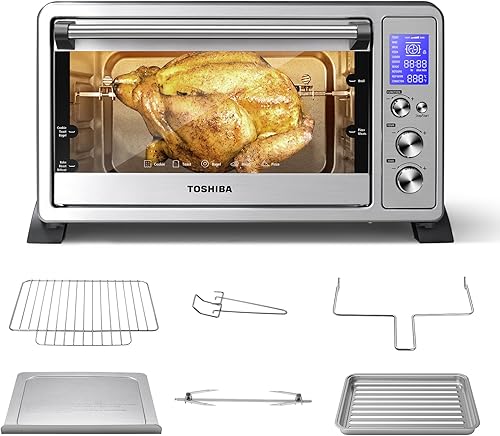
Roasted vegetables, chicken, and anything you want with a crisp exterior benefit the most from convection because the moving air pulls moisture off the surface faster. Cookies and sheet-pan meals cook more evenly because there is no hot zone at the top or cool zone at the bottom. For pizza and flatbreads, consistent bottom-to-top heat keeps the crust from going pale while the top burns. The Toshiba AC25CEW-SS, one of the best-selling countertop convection ovens with over 13,000 ratings at 4.4 stars, reaches up to 450F and draws 1,500 watts, which is enough to replicate the kind of dry, circulating heat that makes sheet-pan cooking reliable. The Elite Gourmet ETO-4510M, rated 4.2 stars across 7,800 reviews at around $160, also tops out at 450F with 1,800 watts and handles larger batches thanks to its bigger cavity.
Where Conventional Ovens Still Make Sense
Delicate baked goods that rely on a slow, gentle rise can be disrupted by a fan blowing directly on them. Custards, souffles, very light cakes, and quick breads often come out better in still air because the airflow can cause uneven rising or form a crust on the outside before the interior sets. Some bread bakers prefer conventional heat for the first half of the bake so the loaf springs upward freely before the crust hardens. If you only ever bake one layer of a single delicate item at a time, a conventional oven is entirely adequate. For everything else, the fan helps.
Temperature and Time Adjustments
Because convection cooks faster, following a conventional recipe without adjusting will typically lead to over-browning or dryness. The standard rule is to reduce the oven temperature by 25F or cut the stated cook time by about 20 percent, but not both at once. Start with the temperature reduction and check food a few minutes early the first time you make something new. This matters more for long-baking items like a roast or a casserole than for something that only takes 12 minutes. The Chefman RJ50-15T, which has collected over 3,700 ratings at 4.3 stars and draws 1,750 watts, offers touch controls that make precise temperature targeting straightforward even when you are dialing down 25 degrees from a conventional recipe.
Countertop Convection Ovens vs Built-In Conventional Ovens
Most homes already have a built-in conventional oven, and most countertop convection ovens are priced from around $75 to $250 for consumer models. A countertop unit does not replace a full range for large holiday meals, but it preheats faster and uses less energy on small everyday jobs. Running a countertop convection oven for a 30-minute bake draws far less power than bringing a full-size range cavity up to temperature. If you are renting or have a poorly calibrated built-in oven, a well-reviewed countertop convection oven is a practical supplement, not just a novelty.
Which One Should You Buy
If you cook a variety of foods including roasts, vegetables, and baked goods, a convection oven is the more flexible tool because you can always turn the fan off (most models let you do this) to simulate conventional behavior. A conventional oven cannot add a fan. For a first countertop convection purchase, look for a model with at least 1,500 watts, a temperature ceiling of 425F or higher, and at least a few hundred real buyer ratings. Stay away from models with fewer than 50 reviews regardless of how good the listed specs look.
Common mistakes to avoid
- Using the same temperature and time as a conventional recipe without any adjustment, which often results in overcooked or overly browned food.
- Turning the fan on for custards, souffles, or delicate sponge cakes that need still air to rise properly.
- Crowding the oven with too many pans, which blocks airflow and defeats the main advantage of convection circulation.
- Buying a countertop convection oven based on review star average alone without checking how many reviews back that rating.
- Assuming all convection ovens are the same: fan placement, wattage, and cavity size all affect real-world performance.
- Skipping the preheat because convection feels faster, when the fan is most effective once the cavity is already at temperature.
Frequently asked questions
Can I use a convection oven exactly like a conventional oven?
Yes, most convection ovens let you switch the fan off so the oven behaves like a conventional model. If you leave the fan on, plan to reduce your target temperature by about 25F or shorten the cook time by around 20 percent. You generally should not do both adjustments at the same time.
Does convection use more electricity than a conventional oven?
Countertop convection ovens typically draw 1,500 to 1,800 watts, which is similar to a toaster oven and far less than a full-size built-in range. Because convection finishes cooking faster, the total energy used per meal is often lower even if the wattage is similar. The energy savings come from shorter run times, not a lower draw.
Is convection worth it for baking cookies?
For most drop cookies and bar cookies, yes. Moving air browns the bottoms and edges more evenly and lets you bake multiple trays at once without rotating them halfway through. Thin, delicate cookies like tuiles or very flat wafers can overbrown quickly, so watch the first batch closely and adjust time or temperature as needed.
What wattage do I need in a countertop convection oven?
A minimum of 1,500 watts is enough for most household cooking tasks and is what you will find in popular models like the Toshiba AC25CEW-SS. Higher wattage, in the 1,750 to 1,800 watt range, gives faster preheating and better recovery when you open the door. Wattage below 1,200 can struggle to maintain temperature with dense foods.
Do I need to cover food in a convection oven?
Covering food works the same way in convection as in conventional: a lid or foil traps steam and keeps the surface moist, which slows browning. If you want a crisp exterior on a roast or baked potato, leave it uncovered so the moving air can dry the surface. If you want a moist interior without a crust (a braised dish, for example), cover it just as you would in any oven.