Countertop Convection Oven Size Guide: Finding the Right Fit
Recommended picks


What Capacity Numbers Actually Mean
Manufacturers list interior capacity in cubic feet, but that number alone does not tell you what fits inside. A 0.5 cu ft cavity is roughly the size of a shoe box and handles toast, bagels, and small frozen snacks well. Step up to around 0.9 to 1.0 cu ft and you gain room for a 12-inch frozen pizza or a 3-pound chicken. At 1.5 cu ft and above, you can fit larger roasting pans and bake multiple trays of cookies at once, though the oven itself may be 20 inches wide or more. The NutriChef PKRTO28, priced around $139.99 with a 1,400-watt element and a 450-degree max temperature, sits in a 16 by 19.6 by 13.5-inch chassis, which gives you a real sense of how much counter space a mid-size unit occupies.
Exterior Footprint and Counter Space
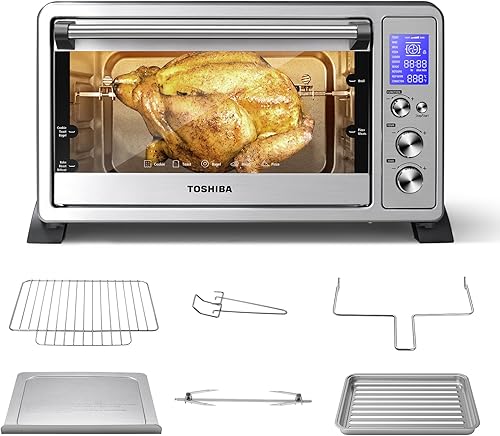
The interior capacity figure tells you nothing about how much counter real estate the oven claims. Always check the full exterior dimensions, including height, before buying. The Toshiba AC25CEW-SS, which has earned more than 13,000 ratings at 4.4 stars and sells for around $73.67, measures roughly 15.86 inches wide, 18.98 inches deep, and 10.82 inches tall, weighing about 16 pounds. That footprint fits under most standard upper cabinets with room to spare. Larger commercial-style units like the Cadco OV-023 run 13.75 inches wide, 18.75 inches deep, and 11.75 inches tall at 62 pounds, reflecting a heavier-duty build that most home kitchens do not need. Always add at least 4 inches on each side and 6 inches above for ventilation clearance when you measure.
Wattage and Electrical Considerations
Most countertop convection ovens draw between 1,200 and 1,800 watts on a standard 120-volt household circuit. The Toshiba AC25CEW-SS pulls 1,500 watts, a common figure for compact to mid-size home units, and that fits safely on a 15-amp circuit shared with light loads. Larger or commercial-grade models step up to 2,700 or 2,800 watts and may require a dedicated 20-amp circuit or even a 240-volt outlet. If your kitchen does not have a dedicated circuit for countertop appliances, verify the wattage of any oven you are considering before purchase. Plugging a high-wattage oven into an overloaded circuit is both a safety risk and a source of tripped breakers.
Sizing for Household Size
For one to two people, a compact oven in the 0.5 to 0.7 cubic foot range handles daily tasks without taking over the counter. Households of three to four people generally benefit from a 0.9 to 1.2 cubic foot unit that can roast a full chicken or bake a 13-by-9-inch pan in one go. Families of five or more who want to replace or supplement a full-size range oven should look at 1.5 cubic feet and above, accepting that the footprint will be substantial. The Hamilton Beach 31103C, rated 4.4 stars across nearly 2,900 reviews and priced around $212.84, targets this middle-household range with a build suited to regular daily cooking.
Clearance, Placement, and Ventilation
Convection fans push hot air through vents on the rear or sides of the unit, so placement directly against a cabinet or backsplash can trap heat, reduce cooking efficiency, and shorten the appliance's lifespan. Most manufacturers recommend at least 4 inches of side clearance and 6 inches of rear clearance as a minimum. Avoid placing any countertop oven directly under a wooden cabinet without checking that the cabinet bottom stays cool during a full bake cycle. If counter space is tight, some owners mount a ventilated shelf above the microwave area or use a sturdy rolling cart, provided the surface is heat-resistant and stable enough to support the oven's weight.
When to Step Up to a Larger Model
A compact oven becomes limiting when you find yourself cooking in multiple small batches for the same meal, when baking sheets do not fit without angling them, or when roasts come out unevenly cooked because the food sits too close to the heating elements. If any of those patterns sound familiar, moving to the next capacity tier is usually worth the extra counter space. Keep in mind that a larger cavity also means longer preheat times and higher electricity use per session, so the upgrade makes sense only if you regularly cook larger volumes. For occasional use, a compact model is almost always the more practical choice.
Common mistakes to avoid
- Buying based on interior capacity alone without checking the exterior dimensions, then discovering the oven does not fit under the upper cabinets.
- Skipping the electrical check and plugging a 1,800-watt oven into an already-loaded circuit, causing repeated breaker trips.
- Pushing the oven flush against the wall or a cabinet side with no ventilation gap, which causes uneven cooking and overheating.
- Choosing the smallest available model to save counter space, then finding it cannot fit a standard 9-by-13 baking pan.
- Ignoring weight when ordering online, then struggling to move or reposition a unit that weighs 20-plus pounds.
- Assuming a higher cubic-foot number means faster cooking. Capacity affects what fits inside, not how quickly the oven heats.
Frequently asked questions
What size countertop convection oven fits a 12-inch pizza?
You need at least 13 inches of usable interior width, which typically corresponds to a 0.7 cubic foot or larger cavity. Check the interior width spec specifically, not just the cubic foot rating, because cavity shapes vary between brands. A unit like the Toshiba AC25CEW-SS with its roughly 16-inch wide exterior gives you a sense of the interior space a common compact-to-mid model provides.
How much counter space should I reserve for a countertop convection oven?
Add the oven's full exterior width plus 8 inches for the total horizontal space needed, accounting for side clearance on both sides. For depth, add the exterior depth plus 6 inches for rear ventilation. Always measure your available counter depth before ordering because some mid-size units run nearly 20 inches deep without the rear clearance added in.
Does a larger convection oven use significantly more electricity?
Yes, generally. A compact 1,200 to 1,500-watt unit costs less to run per hour than a 1,800-watt or 2,700-watt model. The difference matters most if you bake frequently or run long cook cycles. For occasional reheating or toast, the dollar difference is small, but for daily baking the wattage gap adds up over a month.
Can I use a countertop convection oven as my main oven?
Many people do, particularly in smaller apartments or as a way to avoid heating a full-size range oven in summer. The practical limit is batch size, since even a 1.5 cubic foot countertop model cannot fit a full-size roasting pan or a large holiday bird. For everyday cooking for one to four people, a good-quality countertop convection oven handles most tasks competently.
Is there a weight limit I should know about for the counter or a shelf?
Consumer countertop convection ovens typically weigh between 10 and 35 pounds, with commercial-style units running heavier. Standard kitchen counters handle this comfortably. If you plan to use a wire rack, a cart, or a shelf unit, verify its rated load capacity before placing a 20-plus-pound appliance on it. A shelf that shifts or tips during cooking is a burn and fire risk.