How to Choose a Convection Oven: A Plain-English Buying Guide
Recommended picks


Understand What Convection Actually Does
A convection oven adds a fan, and sometimes a second heating element, to circulate hot air around your food. That circulation cuts cook times by roughly 20 to 25 percent compared to a standard oven and browns food more evenly because there are no cold spots. For baking cookies, roasting vegetables, or crisping chicken skin, the fan makes a real, measurable difference. Where convection matters less is delicate items like custards or souffles that need still, gentle heat. Knowing this helps you decide how much to spend on convection power.
Pick the Right Capacity for Your Household
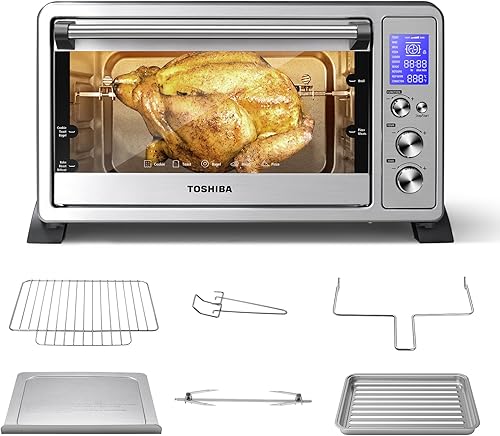
Countertop convection ovens range from around 0.7 cu ft for compact solo-use models up to 2.3 cu ft or larger for family-sized cooking. The Toshiba AC25CEW-SS, one of the most-reviewed ovens in this category with over 13,000 ratings, fits a standard 12-inch pizza or a 9x13 baking dish. Larger units like the Avantco CO-28, at 2.3 cu ft, handle bigger batches but take up more counter space. A good rule of thumb: if you cook for two, look at 1 to 1.5 cu ft; for four or more, aim for 1.5 cu ft and up. Also check the interior dimensions, not just cubic footage, because a low ceiling can block sheet pans even in a nominally large oven.
Match Wattage to How You Cook
Wattage drives how quickly the oven reaches temperature and recovers heat after you open the door. Most countertop models land between 1400W and 1800W. The Chefman RJ50-15T runs at 1750W and has drawn over 3,700 ratings, suggesting it handles everyday demand well. The Elite Gourmet ETO-4510M runs at 1800W, also topping out at 450 degrees F, and carries over 7,800 ratings. If you regularly cook thick cuts of meat or do high-heat pizza, prioritize 1700W or higher. For reheating and light baking, 1400W to 1500W is enough and typically costs less.
Check the Maximum Temperature
Max temperature determines what you can and cannot cook. Most countertop convection ovens cap between 450 and 500 degrees F, which covers baking bread, roasting, and most pizza. The NutriChef PKRTO28 reaches 450 degrees F, the Nuwave Bravo Pro XL goes to 500 degrees F, and the Avantco CO-28 pushes to 550 degrees F for more aggressive browning. If you want truly crispy pizza or high-heat searing, look for 475 degrees F or higher. If you mostly bake cakes and casseroles, 450 degrees F is more than enough and you will not pay extra for a spec you never use.
Compare Control Types: Knob vs. Touch vs. Digital
Knob controls are durable, easy to clean, and intuitive for quick adjustments. Most mid-range ovens use them, including the Toshiba AC25CEW-SS and Elite Gourmet ETO-4510M. Touch controls, found on units like the Chefman RJ50-15T and Hamilton Beach Professional 31240, add precision presets and a cleaner look but can be less responsive if your hands are wet or greasy. Digital displays help you monitor time and temperature at a glance. Neither type is better outright; it comes down to how you prefer to cook. If you move quickly in the kitchen, a responsive physical dial is often faster than hunting through a menu.
Factor In Build Quality and Counter Footprint
Stainless steel interiors and exteriors hold up better over time and resist staining from grease splatter. Most quality countertop ovens in this category use stainless for the outer casing. Weight is a rough proxy for frame rigidity: the Elite Gourmet ETO-4510M comes in at 24 lb, and the Chefman RJ50-15T at 16 lb, both reasonable for regular counter use. Measure your available counter space, including clearance above the unit for heat venting, before you buy. The Toshiba AC25CEW-SS is about 16 by 19 by 11 inches, a footprint that fits most standard counters without crowding.
Common mistakes to avoid
- Buying by price alone without checking interior dimensions, then finding a full-size sheet pan does not fit
- Ignoring the max temperature and later discovering the oven tops out 50 degrees below what a recipe calls for
- Overlooking the counter footprint and losing more workspace than expected
- Assuming higher wattage always means better results without considering that lightweight construction leads to uneven heat retention
- Skipping a check on rack positions, which determines whether you can fit a whole chicken with clearance to spare
- Buying a model with very few reviews without considering that return data and long-term durability are largely unknown
Frequently asked questions
What is the difference between a convection oven and a toaster oven?
A toaster oven is a broad category that includes any small countertop oven. A convection oven specifically has a fan that circulates hot air. Many products are both: a toaster oven with a convection setting. If a listing says convection, look for mention of an actual fan, not just a heating element, to confirm you are getting true air circulation.
How much wattage do I need for baking bread?
Most bread recipes bake between 375 and 450 degrees F, and a 1500W oven can reach and hold those temps without trouble. A 1800W model will preheat faster, which helps if you bake frequently or in batches. For occasional loaves, the wattage difference rarely matters enough to justify a higher price.
Can a countertop convection oven replace a full-size oven?
For a household of one or two people it often can, especially for everyday meals and baked goods. Larger families will run into capacity limits when cooking big roasts or multiple trays at once. Countertop models also struggle with very large items that need 12 or more inches of height clearance.
Is stainless steel interior worth paying more for?
Stainless interiors are easier to wipe clean and do not absorb odors the way dark enamel sometimes can. For frequent cooks, the durability difference shows up over years of use. If you bake or roast several times a week, it is worth the modest price premium. For occasional use, an enamel or painted interior holds up fine.
What should I do if the oven I want has very few reviews?
Treat low review counts as a data gap, not a quality signal. A 5-star rating on 2 reviews tells you almost nothing. Stick to models with at least 100 ratings for a more reliable picture of real-world satisfaction, or contact hello@chpizza.com if you have specific questions about a model you are considering.