Stand Mixer Wattage Explained: How Much Power Do You Actually Need?
Recommended picks


What Wattage Numbers Actually Mean
Watts measure the rate at which a motor draws electricity, not the torque delivered to the bowl. Two mixers rated at 500W can feel very different depending on how efficiently the motor converts power to rotation. That conversion depends on motor type, gear material, and how the head tilts or lifts. Think of wattage as a floor, not a ceiling: a model rated below 300W is almost certainly underpowered for stiff doughs, while anything at 500W or above can handle the full range of home baking tasks if the rest of the machine is solid. Always read the specs alongside real buyer feedback rather than treating the watt number as the only measure of performance.
Wattage Ranges and What They Cover
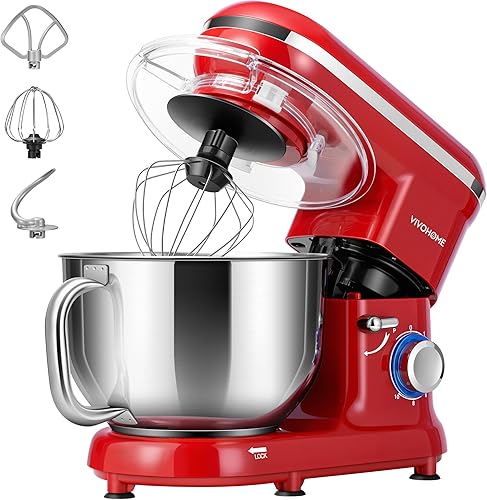
Under 300W: good for whipping cream, beating eggs, and thin batters. The Ovente SM680R (250W, 5-speed, 3.5-qt bowl) is a fair example of this tier, priced around $60 and rated 4.1 stars across 302 reviews. 300W to 499W: handles most cookie doughs and standard cake mixes without issue, though it may slow on very stiff bread doughs. The Vivohome VH1566CA-RE sits here at 380W and earns a 4.4 rating from 336 buyers at $82. 500W to 659W: the sweet spot for general home baking. Most mid-range machines land in this band. 660W and above: designed for frequent bread baking, large batches, or dense mixtures like pizza dough and bagels.
Real Products Across the Wattage Spectrum
The Cusimax Stand Mixer (650W, 8 speeds, $89.98) earns a 4.4-star rating from 6,619 buyers, making it one of the most reviewed options in this silo. At 650W it sits near the top of the mid-range band and handles both wet batters and firmer doughs. The Vivohome VH291-RE (660W, 10 speeds, 6.0-qt bowl, $134.99) carries a 4.5-star rating from 3,733 reviews and adds a larger bowl for bigger batches at the same wattage level. For buyers who want a name-brand option at 500W, the Cuisinart SM-50BCC (500W, 12 speeds, $299.95) holds a 4.6-star rating from 880 buyers and shows that 500W is sufficient for the full range of home recipes when paired with quality engineering. These three cover budget through mid-range with verified buyer satisfaction.
Motor Efficiency vs. Raw Wattage
A mixer with a direct-drive or all-metal gear system turns more of its rated watts into usable torque at the hook or beater. Cheaper models route power through plastic components that absorb energy as heat and wear, which is why they often bog down at lower loads than their watt rating implies. Weight can be a clue: heavier machines tend to use denser motor windings and metal gearing. The Koolatron 0849090 (500W, 10 speeds, 5-qt bowl) weighs 30 lb at $400, while budget 500W models weigh under 12 lb. That weight gap reflects real differences in how the motor is built, not just the body material.
Matching Wattage to Your Baking Habits
If you bake bread once a week or more, treat 500W as a minimum and prefer 600W or higher. If your main use is birthday cakes, cookie dough, and whipped cream a few times a month, 350W to 500W is plenty and keeps the price lower. Batch size matters too: a 500W motor on a 3.5-qt bowl works harder per unit of dough than a 500W motor on a 6-qt bowl, because the larger bowl lets the hook move through dough more freely with less resistance per rotation. Match the bowl size and the wattage together rather than optimizing one in isolation.
When More Wattage Is Not Worth the Price
Commercial-grade machines like the Hobart HMM20-1STD (20-qt bowl, 204 lb, $3,989) or heavy-duty commercial Yokoma options (2200W, 30-qt bowl) are built for high-volume professional use, not home kitchens. Paying for 1200W or 1500W in a countertop home mixer rarely delivers a meaningful benefit over 600W to 700W unless you are running the machine for hours at a stretch or mixing quantities measured in pounds of flour per batch. For most households, anything over 700W is overkill and the money is better spent on bowl capacity, speed range, or attachment compatibility.
Common mistakes to avoid
- Assuming higher wattage always means more power delivered to the dough. Motor efficiency and gear design matter as much as the rated number.
- Buying a 250W to 300W mixer and expecting it to handle stiff bread doughs. Light-duty motors overheat and wear out quickly on heavy loads.
- Ignoring bowl size when comparing wattage. A 500W motor on a 3.5-qt bowl works harder than the same motor on a 6-qt bowl for the same recipe.
- Treating wattage as the only spec to compare. Speed range, bowl material, and attachment type all affect real-world mixing performance.
- Overspending on 1000W or higher for a standard home kitchen. For everyday baking, 500W to 660W covers the full recipe range without extra cost.
- Dismissing low-cost mixers solely because of wattage. The Cusimax at 650W and $89.98 outperforms some pricier 500W models on common baking tasks based on buyer volume and ratings.
Frequently asked questions
Is 500W enough for bread dough?
Yes, 500W is enough for standard home bread recipes in batches of one to two loaves at a time. The Cuisinart SM-50BCC runs at 500W with 12 speeds and earns a 4.6-star rating from 880 buyers, which suggests real-world satisfaction at that power level. If you bake large batches of dense doughs several times a week, stepping up to 600W to 660W gives you extra headroom and reduces motor strain.
Why does my low-wattage mixer smell like burning when I make pizza dough?
That smell usually means the motor is overheating because the load exceeds what the motor can sustain continuously. Mixers below 350W are not designed for stiff doughs and will degrade faster if pushed into that territory regularly. If you make pizza or bread dough more than occasionally, move up to a 500W or higher model with a metal gear system to avoid this problem.
Does a heavier stand mixer mean a better motor?
Not always, but weight is often a useful signal. Metal windings, cast housings, and all-metal gear trains add mass that translates to durability and efficiency. Very light 500W mixers (under 10 lb) typically use smaller motor cores and plastic gearing, which limits how long they can sustain full load. A machine like the Vivohome VH291-RE at 11 lb for 660W sits in a reasonable middle ground for a budget pick.
What wattage do I need for a stand mixer used mostly for cakes and cookies?
For cakes, cookies, and whipped toppings, 300W to 500W is sufficient. These tasks involve wet batters and soft fats that put very little strain on the motor. Spending extra for 600W or above only pays off if you also plan to make yeast breads or other stiff doughs. Match the wattage to your heaviest planned task, not your most common one.
Can I compare stand mixer wattage across brands directly?
You can use it as a rough guide, but do not treat it as an exact comparison. Brands measure and report motor output differently, and some list peak draw rather than sustained operating wattage. Reading buyer reviews from people who make bread or dense doughs gives you a more reliable picture than the spec sheet number alone.