What Loaf Size Do I Need for a Bread Machine?
Recommended picks


How Loaf Size Is Measured
Bread machine loaf size refers to the finished weight of the baked loaf, not the volume of the pan. A 1 lb loaf yields roughly 8 slices, a 1.5 lb loaf about 12, and a 2 lb loaf around 16, though slice count depends on how thick you cut. Many machines can bake two or three sizes by adjusting the recipe, so a machine listed as '1.5 lb to 2 lb' gives you flexibility. The pan shape also matters: horizontal pans produce a wide, sandwich-style loaf, while vertical pans make a taller, squarer loaf. Neither is better, but knowing the difference helps you match the machine to how you plan to use the bread.
1 Lb Machines: Who They Actually Fit
A 1 lb machine is genuinely useful for one person who eats bread slowly and wants the smallest possible countertop footprint. The main drawback is that most recipes are written for 1.5 lb or 2 lb yields, so you will need to scale ingredients down every time. If you entertain occasionally or want to try specialty loaves with add-ins like nuts or dried fruit, the smaller pan fills up fast and can overflow. For most buyers, the 1 lb size is more limiting than helpful.
1.5 Lb Machines: The Middle Ground
A 1.5 lb machine is the most common entry point and covers one to three people comfortably. The Cuisinart CBK-110P1ES, rated 4.4 stars across more than 16,000 reviews and priced around $119.95, is a well-regarded 550W machine with 12 programs that handles 1.5 lb loaves without issue. Recipes at this size are widely available and rarely need adjustment. The loaf lasts two to three days for a small household, which is a reasonable bake cadence for most people. Compact machines in this category also tend to have smaller footprints, which matters on a crowded counter.
2 Lb Machines: Best for Families and Regular Bakers
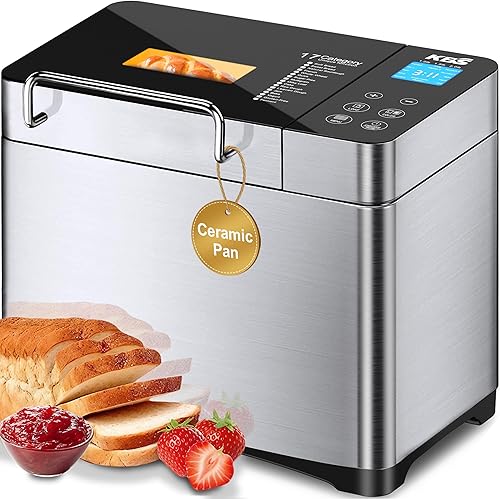
A 2 lb machine is the most versatile size and the one that covers the widest range of situations. The KBS MBF-010, rated 4.4 stars across more than 11,000 reviews at $129.99, runs 710W and offers 17 programs, handling both 1.5 lb and 2 lb recipes. For three to five people, a 2 lb loaf every two to three days is realistic. Larger machines also tend to come with more programs, including gluten-free, rapid, and dough-only settings, because there is more room for a bigger motor and control board. The BB-PDC20BA, rated 4.6 stars across nearly 4,900 reviews, is a heavier-duty 700W option at $454.95 for bakers who want a serious machine built to last.
2.5 Lb Machines: When to Go Large
Some machines advertise a 2.5 lb capacity, and they are worth considering if you bake sandwich bread for five or more people or want a single bake to cover a full week for two. The trade-off is bulk: a 2.5 lb machine is noticeably bigger on the counter and harder to store in a cabinet. Recipe adaptation is also required for most published recipes, which target 1.5 lb or 2 lb. Unless your household reliably goes through bread fast enough to justify it, the 2 lb machine is the more practical ceiling for home use.
Matching Loaf Size to Wattage
Wattage and loaf size are connected. Machines with lower wattage, around 450W to 550W, are generally sized for 1 lb to 1.5 lb loaves. Higher-wattage machines at 650W to 710W and above handle 2 lb doughs more reliably because denser doughs need more motor power to knead properly. Under-powered machines straining through a 2 lb whole-wheat loaf can produce dense or improperly mixed results. When comparing models, check that the wattage is proportional to the maximum loaf size the manufacturer advertises.
Common mistakes to avoid
- Buying a 1 lb machine to save counter space, then finding nearly every recipe needs to be scaled down.
- Assuming a larger machine can only bake large loaves. Most 2 lb machines handle 1 lb and 1.5 lb recipes just fine.
- Ignoring wattage. A 450W machine is not well-suited to a 2 lb dense whole-grain loaf, regardless of what the label says.
- Choosing loaf size based on pan volume rather than finished loaf weight, which is how recipes are calibrated.
- Not accounting for how quickly the household actually eats bread. A 2 lb loaf that sits for five days in a warm kitchen will go stale or mold before it is finished.
- Overlooking pan shape. A vertical pan in a compact machine may only accommodate a 1.5 lb loaf even if the machine is advertised for 2 lb.
Frequently asked questions
Can I bake a smaller loaf in a bigger machine?
Yes, in most cases. A 2 lb machine can bake a 1 lb or 1.5 lb loaf without a problem, and the result is typically the same quality. The advantage of sizing up is flexibility: you can go small on a weekday and bake a full loaf for the weekend without switching machines.
How many slices does a 1.5 lb loaf produce?
A 1.5 lb loaf yields roughly 12 slices at a standard half-inch thickness. That covers two to three days for one person or a single day for a family of four. Slice count varies with how densely the dough bakes and how thick you cut.
Does loaf size affect bake time?
Generally, yes. A 2 lb loaf takes longer to bake than a 1 lb loaf because there is more dough to heat through. The difference is usually 20 to 40 minutes depending on the recipe and machine. Most machines have a rapid-bake setting that shortens total time at the cost of a slightly denser crumb.
What loaf size is best for gluten-free bread?
Gluten-free doughs tend to be wetter and heavier than wheat doughs, so they benefit from a machine with a 700W or higher motor and a 2 lb capacity. A smaller, lower-wattage machine may struggle to knead gluten-free dough evenly, which leads to gummy or under-mixed results. Check that the machine specifically lists a gluten-free program before buying.
Does a bigger loaf size mean a bigger machine footprint?
Mostly, yes. A 2 lb capacity machine is wider or taller than a 1 lb machine from the same brand, and a 2.5 lb machine is bigger still. If counter space is a hard constraint, look for compact models that max out at 1.5 lb, and measure the footprint before you order since box dimensions and product dimensions can differ.