How to Choose a Toaster Oven That Actually Fits Your Kitchen
Recommended picks


Start With Capacity
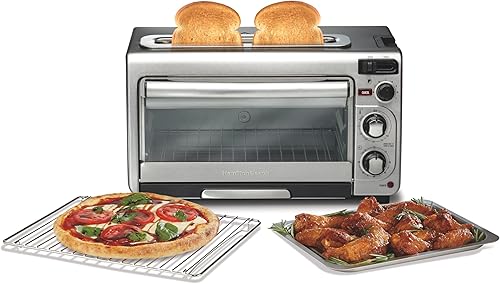
Toaster oven capacity is listed in cubic feet or, for larger countertop ovens, in quarts. A 0.2 cu ft oven fits two slices of bread and a single small tray, which is enough for solo use or occasional reheating. Step up to 0.5 to 0.6 cu ft and you can fit a 12-inch pizza, a four-slice toast batch, or a small roasting pan, which covers most family-of-two or family-of-four needs. If you plan to roast a whole chicken or bake a 9-by-13-inch pan, look at countertop ovens rated around 1.0 cu ft. Keep in mind that a bigger cavity almost always means a bigger footprint, so measure your cabinet clearance above the unit as well as the width.
Wattage and How It Affects Cooking
Wattage tells you how fast the oven heats up and how evenly it holds temperature. Models at 650W to 800W, like the Elite Gourmet ETO236 (650W, $29.99), are slow to preheat and work best for basic toast or reheating. Most mainstream toaster ovens land between 1200W and 1800W, which is the practical sweet spot for baking and broiling. The Emeril 4-00675-02X-VN runs at 1700W with a stainless steel build and a 4.4-star rating across 16,800 reviews at $149.99, a sign that higher wattage at a moderate price point earns real-world trust. Higher wattage also means the oven recovers faster when you open the door mid-cook, which matters more than most people realize.
Controls: Knob vs. Touch Panel
Knob controls are simple, durable, and easier to clean. You can adjust time and temperature without looking at a manual, and there are no circuit boards to fail from steam or grease. Touch panels give you more precise settings and often unlock preset cooking functions like air fry, dehydrate, or proof dough. They are slightly harder to wipe down if grease gets into the button gaps. If you want a no-fuss everyday oven, a knob model is the safer long-term pick. If you want preset programs and exact degree control, a touch-panel unit earns its place, provided you keep it clean.
Cooking Functions: What You Actually Need
Basic toaster ovens offer toast, bake, and broil. That covers about 90 percent of daily use for most households. More advanced countertop ovens add convection, air fry, roast, dehydrate, warm, and sometimes pizza or bagel modes. Convection is the single most useful upgrade because it circulates hot air for faster, more even baking. If you are replacing a full-size oven for everyday cooking, a model with convection and at least bake and broil is a solid floor. If you just want to reheat leftovers and make morning toast, a three-function knob oven at a lower price point does the job without wasted features.
Size, Weight, and Counter Fit
Toaster ovens vary more in physical size than most buyers expect. The Hamilton Beach 31344DA measures 8.97 by 16.12 by 11.93 inches and weighs 8.2 pounds, easy to slide in under a cabinet or move when needed. The Hamilton Beach 31156 runs 12.05 by 17.8 by 10.24 inches at 14.78 pounds, which is a meaningfully larger footprint for its extra capacity. Large countertop-style ovens can stretch past 20 inches wide and weigh over 20 pounds, which means they stay wherever you put them. Measure twice: width, depth, and the height clearance above your counter before buying anything larger than a compact unit.
Budget Ranges and What to Expect
Under $50 buys a basic two- to four-slice oven with knob controls and enough power for toast and simple reheating. The $50 to $120 range is where most buyers land, covering units with 0.5 to 0.6 cu ft of space, 1200W to 1800W, and either knob or touch controls. From $120 to $200 you start seeing built-in air fry, higher wattage, and more durable builds with better rack systems. Above $200, the step up is usually a larger interior, more precise temperature control, or a premium finish, not necessarily better everyday performance for average cooking tasks. Match your budget to your actual use, not to the longest feature list.
Common mistakes to avoid
- Buying by exterior photo without checking interior dimensions, then finding a 9-by-13 pan does not fit
- Choosing a low-wattage model under 1000W to save on electricity, which actually results in longer cook times and uneven heat
- Skipping the counter measurement and ending up with an oven that blocks a cabinet door or overlaps the stove
- Assuming all touch-panel ovens have convection, many at the lower price tiers do not
- Choosing a large countertop oven for occasional toast and reheating, then resenting the counter space it permanently occupies
- Ignoring the crumb tray design, a tray that does not slide out fully or seal poorly makes cleanup much harder over time
Frequently asked questions
What size toaster oven do I need for a family of four?
A 0.5 to 0.6 cu ft oven handles most family-of-four tasks, including 12-inch pizzas, a four-slice toast batch, and small baking pans. If you regularly roast chicken or bake full-size casseroles, step up to a countertop oven with closer to 1.0 cu ft of interior space. Measure your most-used baking pan first and confirm it fits the interior cavity dimensions the brand lists.
Is higher wattage better in a toaster oven?
Generally yes, up to a point. Models between 1400W and 1800W preheat faster and hold temperature more steadily than units under 1000W. Very high wattage matters less once you clear 1800W for countertop-sized ovens, because you hit diminishing returns on preheat speed. What matters more at the high end is how evenly the heating elements and fan distribute that heat.
Do I need convection in a toaster oven?
Convection is worth having if you bake cookies, roast vegetables, or cook chicken pieces regularly. The circulating fan reduces hot spots and cuts cook time by roughly 20 to 25 percent compared to a non-convection setting at the same temperature. For pure toast and reheating, convection adds no real benefit, so skip it if those are your only tasks and it pushes you past your budget.
How do I know if a toaster oven will fit on my counter?
Measure the available width and depth on your counter, then add at least one inch of clearance on each side and three to four inches at the back for heat venting. Also measure the height from counter to the bottom of any wall cabinets above, since most toaster ovens need a few inches of clearance above the unit. Compare those numbers against the product dimensions, not just the interior capacity listed in cubic feet.
Who should I contact with questions about this guide?
You can reach the ChPizza team at hello@chpizza.com. We are happy to answer questions about specific models or help you figure out which size and feature set matches your cooking habits.