What Size Toaster Oven Do I Need?
Recommended picks

How Toaster Oven Capacity Is Measured
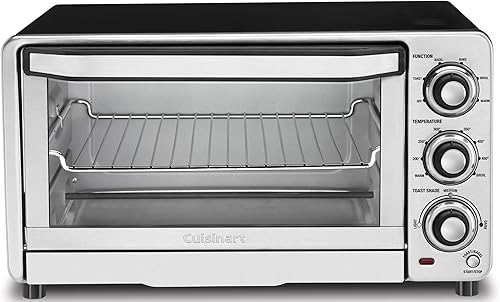
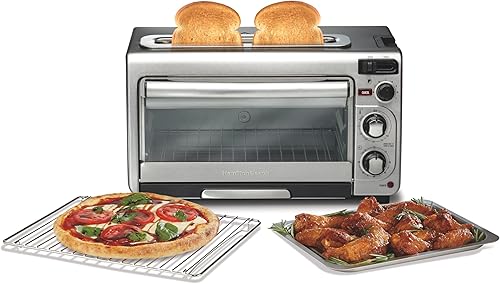
Manufacturers list interior volume in cubic feet, and that number matters more than the outside dimensions. A 0.2 cu ft oven, like the Hamilton Beach 31344DA ($59.95, 4.4 stars, 9,100 ratings), has an interior roughly 8 inches wide by 6 inches deep, which is enough for two slices of bread but not a full pizza. A 0.5 cu ft model, such as the Cuisinart TOB-40NNAS ($99.95, 4.2 stars, 7,400 ratings), adds enough room for a small frozen pizza or a batch of cookies. The Hamilton Beach 31156 at 0.6 cu ft ($99.95, 4.4 stars, 10,000 ratings) goes a step further and fits a 12-inch pizza with room for the rack to sit in multiple positions. When a listing shows dimensions instead of cubic feet, multiply interior width by depth by height, then divide by 1,728 to get cubic feet.
Compact Models: Under 0.3 Cu Ft
Compact toaster ovens are the right pick for tight kitchens, office break rooms, or anyone whose only real use is toasting bread, reheating a slice of pizza, or warming a pastry. The Hamilton Beach 31344DA draws just 1,200 watts and sits at 8.97 x 16.12 x 11.93 inches on the outside, so it fits under most kitchen cabinets easily. The trade-off is that you cannot bake a full sheet of cookies, roast a whole chicken breast, or fit a 9-inch round cake pan. If you currently own a full-size range and want a toaster oven mainly to avoid heating up the big oven in summer, a compact model does the job for everyday toast and small snacks.
Mid-Size Models: 0.4 to 0.7 Cu Ft
The mid-size range is where most buyers land, and for good reason. A 0.5 cu ft unit like the Cuisinart TOB-40NNAS runs 1,800 watts, tops out at 450 degrees F, and measures 11.74 x 17 x 8.35 inches on the counter. That footprint is manageable and the interior fits a 6-slice toast load, a small casserole dish, or a whole cornish hen. Step up to 0.6 cu ft, represented by the Hamilton Beach 31156 at the same $99.95 price point, and you gain just enough extra room for a 12-inch pizza or a larger roasting pan. Couples and small families who bake occasionally, reheat leftovers, and want to skip the big oven most weeknights will find a mid-size oven handles 90 percent of what they ask it to do.
Full-Size Models: 0.8 Cu Ft and Up
Full-size toaster ovens, sometimes called countertop ovens, are built for households that use them as a primary or near-primary oven. They typically accommodate a 13x9 baking pan, a 5-pound chicken, or two oven-safe dishes at once. The outside dimensions run 20 inches or wider, so measure your counter space and clearance before buying. These models also draw more power and take longer to heat, though their larger thermal mass means more even baking once they are up to temperature. If you bake bread regularly, roast a turkey breast several times a year, or cook for four or more people most nights, the extra investment in a full-size countertop oven pays off in versatility.
Other Factors That Affect Usable Size
Interior volume alone does not tell the whole story. Rack position matters: an oven with two rack positions gives you more flexibility than one with a single fixed rack, even if the cubic footage is identical. Wattage affects how quickly the oven climbs to temperature and how evenly it holds heat. The Cuisinart TOB-40NNAS at 1,800 watts heats faster than a 1,200-watt compact, which shows up most when you are baking or roasting rather than just toasting. Door angle and interior shape also affect what actually fits, since a narrow but deep oven may accommodate a 12-inch pizza while a wider but shallower one cannot. Always check whether the brand lists what size pizza, pan, or number of slices the oven is designed to hold, and compare those claims against the baking dish or pan you already own.
Matching Size to Your Counter Space
Toaster ovens need a few inches of clearance on all sides and above to vent heat safely, so add at least 3 to 4 inches to every listed exterior dimension before measuring your counter. A compact oven that is 17 inches wide effectively needs about 23 to 25 inches of horizontal space once clearance is factored in. If your only available spot is under an upper cabinet, stick with compact or mid-size models and check the height spec carefully. Full-size ovens often stand 12 inches or taller, which rules them out for many standard 18-inch cabinet clearances. Contact us at hello@chpizza.com if you have questions about a specific model and counter setup.
Common mistakes to avoid
- Buying a compact oven to save counter space, then finding it cannot fit the dishes you actually cook with most often.
- Choosing based on exterior dimensions without checking the interior cubic footage or the pan sizes the manufacturer lists.
- Assuming a higher wattage always means a larger oven. Wattage affects heating speed, not interior volume.
- Ignoring clearance requirements. Adding 3 to 4 inches on each side and on top is necessary for safe operation.
- Buying a full-size countertop oven without measuring the under-cabinet height, only to find it does not fit the available space.
- Picking the smallest model because it costs less, without accounting for the frustration of running two batches every time you bake cookies or heat leftovers for more than one person.
Frequently asked questions
What is the most common toaster oven size for a family of four?
A 0.6 cubic foot oven is the most practical starting point for a family of four. That capacity accommodates a 12-inch pizza, a 9x13 baking dish, or enough chicken pieces for four servings. If the family bakes frequently or wants to roast larger cuts of meat, stepping up to 0.8 cu ft or more makes daily cooking less of a juggling act.
Can a toaster oven replace a full-size oven?
A full-size countertop oven in the 0.8 cu ft range can handle most everyday cooking tasks and works well as the primary oven in small households or apartments. It cannot fit a large turkey or multiple full-size sheet pans at once, and baking results can vary more than in a calibrated wall oven. For a couple or a single person who bakes cakes, roasts chicken, and reheats regularly, it is a reasonable substitute for most meals.
How do I know if a pan I already own will fit inside a toaster oven?
Check the manufacturer's listed interior dimensions and compare them to your pan's outer dimensions. Leave at least half an inch of clearance on each side so heat can circulate. Many product listings also state which pan sizes fit, such as a 9x9 baking dish or a 12-inch pizza. If the listing only shows cubic footage, the Hamilton Beach 31156 at 0.6 cu ft, for example, has a published interior that fits a 12-inch pizza, which gives a useful reference point for comparing other models.
Does a larger toaster oven use more electricity?
Generally, yes. A full-size countertop oven running 1,800 watts draws the same power per hour as a mid-size model at 1,800 watts, but it typically runs longer to preheat the larger cavity. Compact ovens at 1,200 watts, like the Hamilton Beach 31344DA, use less electricity per session for small tasks such as toast. The practical difference in your monthly electricity bill is small compared to running a full-size range, so energy cost should be a secondary factor after choosing the right interior volume for your cooking habits.
Is a bigger toaster oven always better?
Not necessarily. A larger oven takes up more counter space, takes longer to preheat, and can produce uneven results at very small loads because the heating elements are spaced for a larger interior. If you toast two slices of bread most mornings and occasionally reheat a slice of pizza, a 0.2 to 0.3 cu ft compact oven will serve you faster and waste less energy than a full-size model sitting mostly empty.